

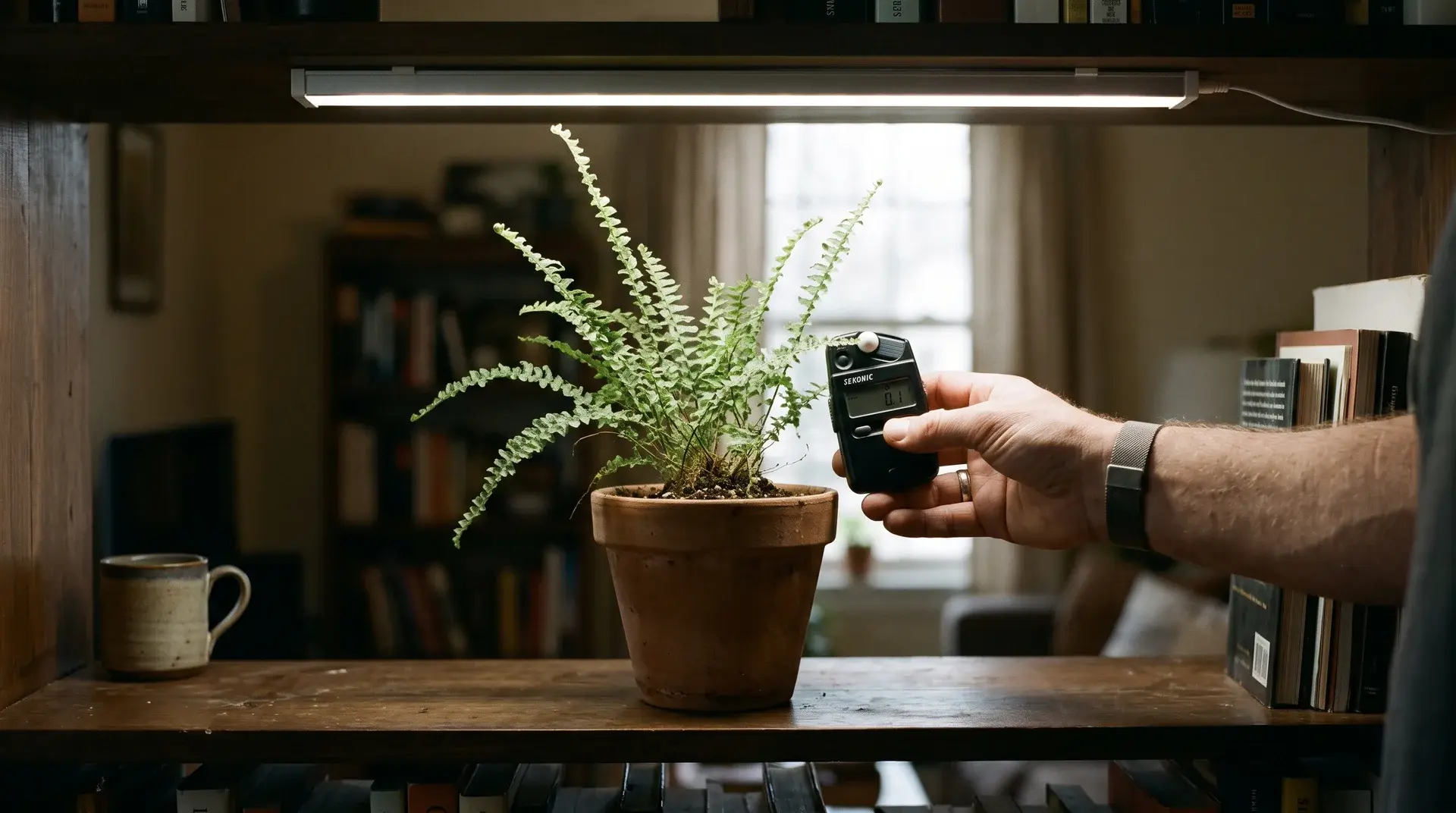
Why lux, foot-candles, and PPFD refuse to convert cleanly under LEDs, and how to get within 20% with a $30 meter
Time: 21 - 28 minutes (6235 words)
Published: November 7, 2026
Category:
You bought a light meter because every serious plant source told you to measure instead of guess. Good call. Then you looked for a way to turn the lux number on the screen into the PPFD number every care guide quotes, and the internet handed you a single rule: divide by 54, or multiply by 0.0185. You did the math, got a number, and trusted it.
That rule is real. It is also for sunlight only, and almost nobody repeating it says so. Under an LED grow light the right factor can be a third higher or a quarter lower, and it changes with the colour of the white. Stack that on a $30 meter that was calibrated against an incandescent bulb, and the PPFD figure you are planning around can be off by half.
Your lux meter isn't lying to you. The conversion factor you were handed is. Lux measures how bright light looks to a human eye. PPFD counts photons a plant can use. There is no single bridge between the two, because every light source builds its brightness out of a different mix of colours. This article gives you the factors that actually hold up, shows you how big the errors get, and tells you plainly what a cheap meter can and cannot do.
Let's Get You Up to Speed
This UG article will help you understand:
- What lux, foot-candles, and PPFD each measure, and why only PPFD describes what a plant receives
- Why a conversion factor that is correct for sunlight is wrong for a 4000K LED, and wrong again for a 2700K one
- How a cheap meter's spectral error and a wrong conversion factor multiply into a 30 to 50% miss
- Which lux-to-PPFD factors are validated, which are derived from manufacturer specs, and which do not exist, and how to apply them with two formulas and worked examples
- Why the cheap "PAR meters" sold on Amazon are mostly lux meters with a different label, and what a real quantum meter publishes that they don't
- When a $30 lux meter is enough, and when only a full-spectrum quantum PAR meter will answer the question
Got Things to Do? This is For You!
There is no universal lux-to-PPFD conversion. The factor depends on the spectrum of the light, and under white LEDs it ranges from about 0.014 µmol per lux for a 4000K to 5000K white to about 0.018 for a 2700K warm white, with the sunlight figure of 0.0185 sitting at the top of that range. Use the sunlight rule on a 4000K grow light and you overstate PPFD by roughly 30% before the meter has made a single error of its own.
Cheap lux meters add 10 to 20% of their own uncertainty under LEDs because they are calibrated against incandescent light and their colour response is never published. Phone apps are worse: an accredited lighting lab measured one phone-and-app combination reading 113% high. Red-heavy and red/blue grow lights break lux conversion entirely, because the human-eye weighting that defines lux counts deep red at about 6% of its real photon value. The $150 "PAR meters" on Amazon are not the shortcut either: side-by-side tests against Apogee meters find they need correction multipliers of 1.3 to 1.8, and the multiplier changes with the tester and the light.
Converting lux to PPFD is a conditional practice. With a white LED and a factor matched to its colour temperature, a cheap meter gets you within about 20%, which is good enough to compare positions and lights. It is not good enough to set a plant-specific PPFD target, and under any light with added red diodes it is not good enough for anything. My standing recommendation for hobbyists is unchanged: the UNI-T UT383BT Bluetooth lux meter paired with the PPFD Meter app, which landed within 11% of an Apogee quantum meter in the one published comparison, for about 6% of the price. For plant-specific targets, borrow or buy a full-spectrum quantum meter.
What's the Difference Between Lux, Foot-Candles, and PPFD?
Lux, foot-candles, and PPFD are three answers to the question "how much light is here," and only one of them is asked from the plant's point of view.
Lux is the SI unit of illuminance: one lumen landing on one square metre. A foot-candle is the same idea in imperial units, one lumen on one square foot, and one foot-candle equals 10.76 lux. Both are built on the lumen , and the lumen is built on the human eye. Photometry weights every wavelength by how bright it looks to a standard human observer, a curve that peaks at 555 nm in yellow-green and falls away steeply toward blue and red. A watt of 555 nm light is worth 683 lumens. A watt of deep red at 660 nm is worth about 42, because our eyes barely register it.
PPFD , photosynthetic photon flux density, throws the eye out of the equation. It counts every photon between 400 and 700 nm landing on one square metre each second, in micromoles , and weights them all equally. That 400 to 700 nm band is PAR , photosynthetically active radiation. A red photon counts the same as a green one. That is the right accounting for a plant, because photosynthesis runs on photon count, not on perceived brightness, and plants use red and blue light that our eyes rate as dim.
Lux tells you how bright a room looks. PPFD tells you how much a plant can photosynthesise. Michigan State's Erik Runkle and Utah State's Bruce Bugbee put it bluntly in a 2013 piece for growers: photometric units are based on human vision and the horticulture industry should stop using them. I agree, which is why lumens on a grow light spec sheet is a red flag, not a feature.
FYI: Foot-candle meters and lux meters are the same instrument with a different label on the display. Divide foot-candles by 10.76 to get lux, or just use 10 if you are doing it in your head. The error from rounding is smaller than the error from everything else in this article.
The catch is that the meters that measure PPFD properly cost several hundred dollars, and the meters that measure lux cost $30. So the hobby does what it always does: it buys the cheap one and looks for a conversion factor. Let's dig in.
Why Doesn't One Conversion Factor Work for Every LED?
One conversion factor does not work because lux and PPFD weight the spectrum differently, so the ratio between them changes every time the spectrum changes.
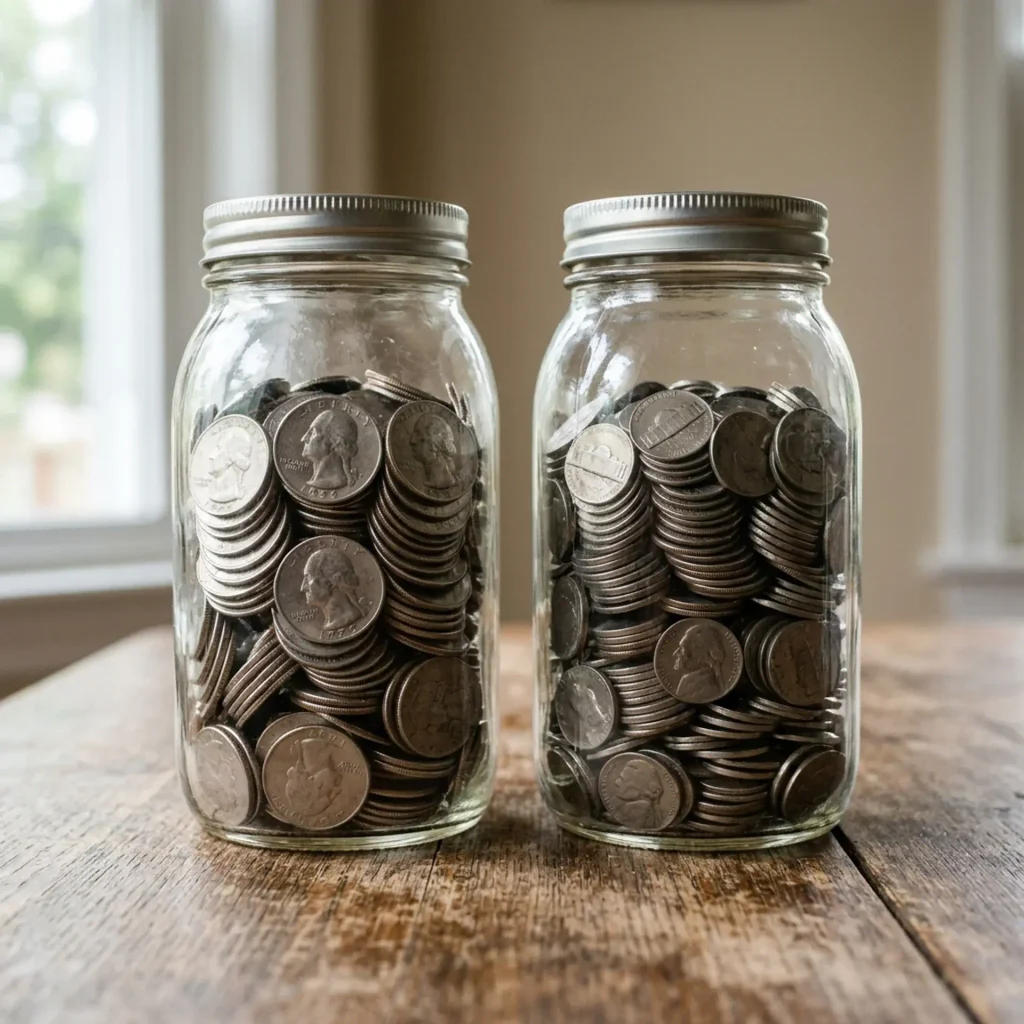
Think of two bags of coins that both total $10. One is all quarters, the other is mostly nickels. Count the coins instead of the value and the bags are nothing alike. Lux is the dollar value, weighted by the eye. PPFD is the coin count. Two lights that read identical lux can deliver very different photon counts if one of them puts more of its output into red and blue, where lux undercounts and PPFD does not.
Apogee Instruments, which manufactures the quantum sensors most horticultural researchers use, publishes the factors below. Each was derived by measuring the full spectrum of the source with a spectroradiometer and computing both quantities from it, following the method laid out by Thimijan and Heins in HortScience in 1983. Sunlight sits at 54 lux per µmol. Cool white fluorescent sits at 74. A mogul-base HPS sits at 82. The same lux reading under those three sources is three different PPFD values, spanning a 50% range.
White LEDs are not one source either. A white LED is a blue chip under a yellow phosphor, and the colour temperature you buy is set by how much of the blue leaks through and how much red the phosphor adds. Warmer whites have more red, which lux undercounts, so a warm white delivers more photons per lux than a cool white. Lighting Analysts, the makers of the AGi32 lighting design software, computed factors from the published spectra of one family of Philips white LEDs: a 2700K part gave 18.1 µmol per kilolux, a 3000K gave 17.1, and the 3500K through 5000K parts all landed between 14.3 and 14.6. That is a 27% swing between the warm end and the neutral end of the same product line.
CRI moves it again. A high-CRI white carries a fuller red tail, so at the same colour temperature it delivers more photons per lux than a low-CRI white. A 2018 preprint by Sharakshane, working from the spectra of commercial white LEDs, found the factor rises with lower colour temperature and with higher CRI, and proposed 15 µmol per kilolux as a middle-of-the-road rule for white LEDs with a stated spread of about ±7% around it. Community-compiled factors from Bridgelux datasheets show the same direction at larger magnitude: about 73 lux per µmol for a 3000K CRI 80 chip, falling to about 59 for a 3000K CRI 97 chip. Those last figures are hobbyist-compiled from manufacturer data, not validated, but they agree with the physics.
Myth Check: "1 µmol/m²/s equals 54 lux" is true for sunlight and nothing else. Applied to a 4000K LED it overstates PPFD by about 30%. Applied to a red/blue grow light it is not even wrong, because lux is nearly blind to the light being measured.
Then there are the lights that break the method completely. Red-enhanced "full spectrum" panels with 660 nm diodes added to white, and red/blue "blurple" fixtures, put a large share of their photons where the eye's sensitivity curve has collapsed. The photometric weighting at 660 nm is about 6% of the peak. A lux meter sees a dim pink glow where a plant sees a flood. No fixed factor rescues that reading, because the factor depends on exactly how much red was added, and the box never tells you.
Nerd Corner: Lux is irradiance weighted by the CIE photopic luminosity function V(λ) and scaled by 683 lm/W. PPFD is irradiance divided by photon energy (hc/λ) and summed from 400 to 700 nm, so longer wavelengths contribute more photons per watt than shorter ones. Red light therefore gets a double bonus in PPFD relative to lux: more photons per watt, and almost no photometric weight. That is the whole reason warm, high-CRI, and red-enhanced sources have higher µmol-per-lux factors. The tables below do the work for you.
How Wrong Can a Cheap Lux Meter Be?
A cheap lux meter can be wrong by 10 to 20% on its own under LED light, and that error multiplies with the conversion error rather than adding to it.
Start with what the spec sheet says. A typical $30 meter such as the Dr.meter LX1330B or the UNI-T UT383 series quotes an accuracy of ±3 to 4% of reading plus a few digits. That figure is measured under the lamp the meter was calibrated against, which the LX1330B manual states is a standard incandescent at 2856K. Under that lamp, the meter is as good as it claims. Under an LED it is not, because the filter that is supposed to make the sensor see like a human eye is approximate, and the approximation fails hardest where LED spectra are spikiest: the blue peak and the red tail.
Professional photometers publish that approximation error as a number called f1', the mismatch between the meter's response and the ideal eye curve. The DIN 5032-7 standard sorts meters into classes by it: Class L under 1.5%, Class A under 3%, Class B under 6%, Class C under 9%. No $30 meter publishes an f1' value, and the German lighting metrology firm Gigahertz-Optik states plainly that spectral mismatch is usually the single largest error source when a photometer is pointed at an LED. Sharakshane's review of the same standard puts the realistic luxmeter error under LEDs at 10 to 20%.
Now stack it. Say the true PPFD at your leaf is 200 µmol/m²/s under a 4000K white LED. The correct lux reading is about 14,000. A meter reading 15% high shows 16,100. You apply the sunlight factor, 0.0185, because that is the one every forum quotes, and you get 298 µmol/m²/s. You believe your plant is at the floor of the 300 to 500 µmol/m²/s target I publish for Monstera. It is at 200. You have a 49% error, and nothing on the meter's display hints at it.
Run it the other way with a warm, high-CRI pendant at 3000K. The true factor is about 0.017. If you grabbed the cool white fluorescent factor of 0.0135 from an old greenhouse table, you undercount by 21% before the meter error, and by over 30% after it. Either direction, the meter looks precise. The display shows four digits. The digits are not the problem.
Stat: Apogee's own spec sheet shows its original, lower-cost quantum sensor reading 65% low under a red/blue LED and 60% low under a red/white LED. Its full-spectrum sensor reads within 3.5% under the same lights. If a dedicated PAR sensor can miss by two-thirds on spectrum alone, a lux meter with no published spectral response has no chance under those lights.
Phone apps extend the problem. DIAL, an accredited German lighting laboratory, tested lux-meter apps across several phones. The worst combination read 1,063 lux against a 500 lux reference, a 113% error. The best read within 3% at 500 lux, then missed by 89% at 100 lux. The same phone and app did not even hold a consistent percentage error across brightness levels, which rules out the "just calibrate it once" fix most people reach for. A grow light retailer's comparison of PAR apps against an Apogee SQ-500 found an iPhone within 3% of the reference under a 3500K plus red LED, and an Android phone 33% low under the same light with the same app. The camera sensor in your particular phone decides the answer.
Which Lux-to-PPFD Factors Can You Actually Trust?
The factors below are sorted by how they were obtained. Validated means computed from a measured spectrum by an instrument manufacturer or lighting-science source. Manufacturer-derived means I divided a published PPF by a published lumen figure for a specific product, which carries the tolerances of both specs and assumes the two numbers describe the same unit. Not derivable means the manufacturer has not published enough to compute anything, and any factor you see online for that product was made up.
Table 1. White LED factors by colour temperature (validated, with caveats)
| Light source | µmol per lux (×) | Lux per µmol (÷) | Basis |
|---|---|---|---|
| Sunlight | 0.0185 | 54 | Validated Apogee; Thimijan & Heins 1983 |
| 2700K white LED | 0.0181 | 55 | Validated AGi32, one Philips LED family |
| 3000K white LED | 0.0171 | 58 | Validated AGi32, one Philips LED family |
| 3500K white LED | 0.0146 | 68 | Validated AGi32, one Philips LED family |
| 4000K white LED | 0.0143 | 70 | Validated AGi32, one Philips LED family |
| 5000K white LED | 0.0146 | 68 | Validated AGi32, one Philips LED family |
| 6500K white LED | 0.013–0.0175 | 57–76 | Estimate No validated figure; one LED maker quotes 0.0175, datasheet-derived cool whites sit near 0.013 |
| Generic white LED, CCT unknown | 0.015 | 67 | Preprint Sharakshane 2018, ±7% across white LEDs |
Two caveats travel with Table 1. The AGi32 figures come from one manufacturer's LED family; a different maker's 4000K chip with a different phosphor will not land on exactly 0.0143. And every figure assumes a plain white LED. The moment a product adds 660 nm red diodes to its white, the real factor climbs above anything in this table, and you cannot know by how much without a spectrum.
Table 2. Legacy and non-LED sources (validated, Apogee Instruments)
| Light source | µmol per lux (×) | Lux per µmol (÷) |
|---|---|---|
| Cool white fluorescent | 0.0135 | 74 |
| Metal halide | 0.0141 | 71 |
| Ceramic metal halide, 4200K | 0.0154 | 65 |
| Ceramic metal halide, 3100K red-shifted | 0.0170 | 59 |
| High pressure sodium, mogul base | 0.0122 | 82 |
| Double-ended HPS | 0.0130 | 77 |
Table 2 is here because old greenhouse references, and a surprising number of current web calculators, still default to the fluorescent or HPS figure. If your light is an LED, nothing in Table 2 applies to it.
Table 3. Popular houseplant grow lights: what can and cannot be derived from manufacturer data
| Product (placeholder row) | Published spectrum | Published PPF | Published lumens | Derived µmol per lux | Status |
|---|---|---|---|---|---|
| Sansi 36W Full-Spectrum Bulb | 4000K, CRI "close to 100", 400–780 nm | 65.6 µmol/s | Not on sansiled.com; retail listings show 3,250, 2,700, and 1,448 lm | 0.020 using 3,250 lm; unreliable | Manufacturer-derived, unverified Use 0.0143 (4000K) as a floor; red-enhanced phosphor likely pushes the true figure higher |
| Soltech 3000K Pendant | 3000K, CRI 98, white | 50 µmol/s | 3,000 lm | 0.0167 (60 lux per µmol) | Manufacturer-derived Agrees with the validated 3000K figure within 3% |
| Soltech 3000K Grow Bulb | 3000K, CRI 98, white | ~26 µmol/s | 1,500 lm | 0.0173 (58 lux per µmol) | Manufacturer-derived Agrees with the validated 3000K figure |
| Mother Plant-Spectrum Bar | 3914K, CRI 97, 15% blue / 36% green / 42% red / 6.5% NIR | Not published (PPFD-by-distance table only) | 2,495 lm | Not derivable | Not derivable High CRI and 42% red suggest 0.015 to 0.017; treat as estimate |
| AC Infinity Full-Spectrum Panel | 3000K + 5000K white, plus 660 nm red, 730 nm far-red, 395 nm UV diodes | Published (e.g. 1,819 µmol/s at 300W) | Not published | Not derivable | Lux meter unsuitable Added 660 nm red is invisible to a lux meter; any white-LED factor undercounts |
| Barrina T5 Grow Bar ("full spectrum") | "Yellow", no Kelvin, no CRI, no spectrum graph | Not published | Not published | Not derivable | Not derivable Manufacturer gives wattage and "over 95% absorption" only |
| Barrina T5 6500K Shop Light | 6500K, CRI 85 | Not published | 2,200 lm | Not derivable | Estimate Use the 6500K range from Table 1, 0.013 to 0.0175 |
| Any red/blue "blurple" fixture | Narrow red and blue peaks | Varies | Rarely published, and meaningless | No valid factor | Lux meter unsuitable Quantum meter only |
Read the status column before the numbers. Only two rows in Table 3 produce a factor you can use with any confidence, and both are plain 3000K whites whose derived figure happens to agree with the validated one. I recommend Sansi grow lights regularly and have written about Barrina lights too, and neither brand publishes what you would need to convert a lux reading under their products cleanly. That is not a knock on the lights. It is a statement about the limits of the method.
How Do You Calculate PPFD From Lux or Foot-Candles?
PPFD is estimated from lux by multiplying the lux reading by the µmol-per-lux factor for your light source. From foot-candles, convert to lux first.
From lux: PPFD (µmol/m²/s) = lux × factor
From foot-candles: PPFD (µmol/m²/s) = foot-candles × 10.76 × factor
Or, if you prefer dividing, use the lux-per-µmol column: PPFD = lux ÷ 54 for sunlight, lux ÷ 70 for a 4000K LED, lux ÷ 58 for a 3000K LED. For foot-candles under sunlight, divide by 5.0, the figure Runkle gives in his MSU extension note.
Worked example 1, window light. Your meter reads 5,400 lux at 12" (30cm) from a bright window. The source is daylight, so the sunlight factor applies: 5,400 × 0.0185 = 100 µmol/m²/s. That matches my published figure of about 100 µmol/m²/s at 12" (30cm) from the glass, and it is the one situation where the sunlight rule is the right rule.
Worked example 2, 4000K white LED. Your meter reads 14,000 lux under a 4000K white grow bulb. Using the matched factor: 14,000 × 0.0143 = 200 µmol/m²/s. Using the sunlight factor by mistake: 14,000 × 0.0185 = 259. Using the fluorescent factor from an old table: 14,000 × 0.0135 = 189. Same reading, three answers, 70 µmol/m²/s apart.
Worked example 3, 3000K high-CRI pendant. Your meter reads 12,000 lux. Matched factor: 12,000 × 0.0171 = 205 µmol/m²/s. The 4000K factor would give 172, a 16% undercount, which matters if you are deciding whether a plant has cleared a threshold.
Worked example 4, foot-candles. An older care guide says a plant wants 1,500 foot-candles, and you want that in PPFD under a 4000K LED. 1,500 × 10.76 = 16,140 lux. 16,140 × 0.0143 = 231 µmol/m²/s. Under sunlight the same 1,500 foot-candles would be 1,500 ÷ 5.0 = 300 µmol/m²/s. The old guide almost certainly meant sunlight or fluorescent, so when you reproduce its target under LED you need the LED factor, not the one the guide's author had in mind.
Once you have a PPFD estimate, convert it to DLI with the usual formula, PPFD × hours × 0.0036, and remember that every error above carries straight through into the daily total.
Pro Tip: Measure with the room lights off and the blinds closed, at the leaf, with the sensor flat and facing the fixture. A lux reading that mixes a 3000K grow light with 6500K daylight from the window has no single factor at all.
Why Can't You Just Divide PPF by Lumens?
Dividing a product's published PPF by its published lumens looks like the clean solution, and for a plain white LED it is close. It still fails more often than it works, for four reasons.
First, most houseplant grow lights do not publish both numbers. Of the products in Table 3, exactly two do. Sansi publishes PPF and no lumens on its own site. Mother publishes lumens and no PPF. AC Infinity publishes PPF and no lumens. Barrina publishes neither for its grow bars. You cannot divide by a number that does not exist, and the retail listings that fill the gap are unreliable: three different Amazon and eBay listings for the same Sansi bulb show three different lumen figures spanning more than a factor of two.
Second, PPF counts 400 to 700 nm and lumens count whatever the eye sees. A light whose spectrum runs to 780 nm, as Sansi states for its bulbs, puts photons into far-red that count toward neither. That is fine, but it means the two published figures may have been measured on different units, in different labs, under different drive conditions. Manufacturer tolerances of ±10% on each are routine, so the ratio can be off by 20% even when both numbers are honest.
Third, the ratio tells you the fixture's average factor across its whole output. It does not tell you the factor at your leaf. Lenses and phosphor coatings do not distribute every wavelength identically across the beam, which is one more reason a single-point PPFD rating never describes the whole canopy.
Fourth, a derived factor inherits every marketing liberty in the source numbers. A listing that says "400W equivalent" next to its lumen figure is not a lab report. When a derived factor comes out far from the validated range for its colour temperature, as the Sansi 0.020 does against the validated 4000K figure of 0.0143, the right response is suspicion, not a new table row.
A derived conversion factor is only as good as the weaker of the two numbers it came from. Treat it as a sanity check on the validated tables, never as a replacement for them.
Do Phone Apps and Bluetooth Lux Meters Fix Any of This?
Phone PAR apps and Bluetooth lux meters paired with a conversion app change where the error comes from. They do not remove it.
The pairing readers ask about most is the UNI-T UT383BT, a roughly $30 Bluetooth lux meter, with a third-party app that pulls its readings over Bluetooth and applies a conversion factor from a menu of light types. The app route is better than a phone camera in one respect: a dedicated silicon photodiode behind a filter is a more consistent sensor than a selfie camera with auto-exposure, and UNI-T publishes a range accuracy of ±4% of reading plus 8 digits below 10,000 lux and ±5% plus 10 digits above. That is the same class of spec as any other $30 meter, which means the spectral mismatch question from earlier is unanswered: UNI-T publishes no f1' class and does not state the calibration source. The meter's accuracy under LED is whatever its unpublished filter makes it.
The conversion step is then only as good as the preset you pick. The app offers presets such as "3500K plus 10% red," which is better than a single sunlight constant, but it is still a guess about your fixture's spectrum. In the one published comparison I could find, a grow light retailer measured the UT383BT-and-app pairing against an Apogee SQ-500 under a 3500K plus 660 nm LED and found it 11% high on both iPhone and Android. The same test found the apps' phone-camera modes at 3% low on an iPhone and 33% low on an Android. The retailer sells the UNI-T meter and describes it as "over 95%" accurate, which its own table does not support, so weigh the source accordingly.
Eleven percent is a strong result for a $30 instrument and a free app, and it is why I recommend the UT383BT paired with the PPFD Meter app to hobbyists over any sub-$200 "PAR meter." It is also a single light, a single spectrum preset, and a single tester. Under a red-heavy panel, or with the wrong preset, the pairing inherits every problem in this article.
The value case is simple: a reading within 10 to 20% of what an Apogee would report, for about 6% of the price, is the measurement that actually gets made. Most houseplant light problems are shortfalls of three to 20 times, not 15%, and a meter that is 15% wrong finds every one of them. Pick the preset closest to your light's colour temperature, treat the result as a ±20% band, and reserve the $500 for the day a decision sits inside that band or your fixture carries added red.
Fun Fact: The DIAL laboratory found that the same phone and app that read within 3% at 500 lux read 89% off at 100 lux. Phone light sensors exist to dim your screen, not to measure light, and they are tuned for the brightness range of a face in a room, not a leaf under a grow light.
Why Aren't the Cheap "PAR Meters" on Amazon the Answer?
The cheap PAR meters on Amazon are not the answer because most of them are lux meters with a PPFD label, and the few that carry a real quantum sensor do not publish the one number that would tell you how well it works.
Search "PAR meter" on Amazon and you get two kinds of product. The first kind, priced from $30 to $60, is a lux meter whose firmware multiplies the reading by a fixed factor and displays the result in µmol/m²/s. The listing will say "400 to 700 nm" and "quantum sensor," and the accuracy line will read something like "±4% ±10 digits," which is a lux-meter accuracy spec copied onto a PPFD display. One widely sold model lists exactly that. A fixed internal factor is the sunlight rule from the top of this article with the decision taken out of your hands, and everything in Table 1 about why one factor fails under LEDs applies to it in full. You have paid extra to hide the error.
The second kind, priced from $100 to $200, uses a photodiode with a filter intended to flatten its response across 400 to 700 nm, which is what a quantum sensor is. Whether that filter does its job is the entire question, and the listings do not answer it. A real quantum meter ships with a published spectral response curve and a table of spectral errors under named light sources; Apogee's spec sheets show those for every model it sells, including the embarrassing 65% miss of its own original sensor under red/blue LED. No $150 Amazon meter I could find publishes either. Without that curve you are trusting a stranger's filter under a spectrum they never tested.
The hobbyist evidence says the trust is misplaced, and it says so inconsistently, which is worse. Reef aquarists, who care about PAR more than most houseplant owners, have run the popular $150 meters against Apogee full-spectrum units repeatedly. One tester found a budget meter needed a 1.3× multiplier to match the Apogee under his LEDs; another found 1.02× in air; a retailer's test settled on 1.35×; a video comparison put it at 1.4× and a second at 1.8×. Those are not small disagreements. At a true 350 µmol/m²/s, a meter that needs 1.4× is reading 250, and one that needs 1.8× is reading 194, and you have no way of knowing which multiplier applies to your light. A multiplier that changes with the spectrum is a spectral error, which is exactly the thing a quantum sensor is supposed not to have.
The meters have a second problem that no multiplier fixes. A quantum sensor's head is supposed to be cosine-corrected, so that light arriving from a low angle is weighted correctly. Apogee researchers presenting at the 2018 American Society for Horticultural Science meeting compared seven quantum meters and found the Hydrofarm hobby meter, one of the better-known mid-priced units, had directional errors of up to 20% in diffuse light, with larger errors under low-angle directional light. Diffuse and low-angle light is what a houseplant under a shelf fixture or beside a window receives. The research-grade sensors in the same study held under 5% on both spectral and directional error.
A PAR meter that publishes no spectral response is a lux meter asking for a bigger budget. If the spec sheet does not show you a response curve and a spectral error table, the manufacturer has not measured it, or has and would rather you didn't see it. Spend the $150 on nothing, keep your $30 lux meter and a matched factor, and put the difference toward borrowing or buying a full-spectrum unit when a threshold decision actually needs one.
FYI: Apogee's own lower-cost "original" quantum sensor is sold inside the older Hydrofarm meter and others. It is a real quantum sensor, and it is accurate under sunlight, HPS, and fluorescent. Apogee's own table shows it reading 20 to 65% low under LED fixtures with added red, which is why Apogee replaced it with the full-spectrum series for LED work. A quantum sensor designed before horticultural LEDs is not a quantum sensor for horticultural LEDs.
How Do You Use a Cheap Meter Responsibly?
A cheap lux meter is used responsibly when it is treated as a comparison tool with a known error band, not as a PPFD instrument with a decimal point.
Start with the right cheap meter. I recommend the UNI-T UT383BT with the PPFD Meter app because the app applies a spectrum preset for you, which removes the single largest error in this article before you take a reading. Everything below applies whether you use that pairing or a plain lux meter and a calculator.
Match the factor to the light. If the box says 4000K, use 0.0143. If it says 3000K, use 0.0171. If it says 2700K, 0.0181. If it says nothing, or says "full spectrum" without a Kelvin figure, use 0.015 and widen your error band to ±25%. If it has visible red diodes alongside the white, stop converting, because you do not have a factor.
Keep the meter constant. The 10 to 20% spectral error of a cheap meter is mostly systematic, which means it is roughly the same every time you point it at the same light. If you use one meter and one factor to compare the top shelf to the bottom shelf, or the plant by the window to the plant under the lamp, the systematic error largely cancels. The comparison is good even when the absolute number is not.
Measure where the leaf is, not where the hotspot is. I have already covered why the meter reading at the brightest point is not what the plant experiences; the conversion problem in this article sits on top of that one, not instead of it.
Write down the band, not the number. If your reading converts to 200 µmol/m²/s, record it as 160 to 240. If a plant's canon target is 300 to 500 and your band tops out at 240, you have learned something real: the plant is short of light. If your band is 260 to 340 against a 300 floor, you have learned nothing, and that is the moment the method has run out.
Pro Tip: If a friend, a plant society, or a local shop has a full-spectrum quantum meter, borrow it for an hour. Measure your main fixture with both meters at the same spot and divide the quantum reading by your lux reading. That single number is a conversion factor for your meter under your light, and it is worth more than every table in this article for that one setup.
When Do You Need a Quantum PAR Meter?
You need a quantum PAR meter the moment the question changes from "which position is brighter" to "has this plant cleared its threshold."
The quantum meter does not have a conversion step. A full-spectrum model, such as Apogee's SQ-500 series or LI-COR's LI-190R, has a sensor filtered to respond almost equally across 400 to 700 nm, and the manufacturers publish spectral errors for it under dozens of light types: within about 3.5% under sunlight, HPS, white LED, and red/blue LED alike, with a stated calibration uncertainty of ±5%. Older or cheaper quantum sensors with a narrower response are a different story, which is why Apogee's own table shows its original sensor missing by 65% under red/blue LED. If you buy a PAR meter, buy a full-spectrum one. A cheap "PAR meter" with no published spectral response is a lux meter with a different label.
Price is the honest obstacle. A full-spectrum quantum meter runs several hundred dollars. For a collection of a dozen foliage plants under two or three white LED fixtures, a borrowed one for an afternoon, used to calibrate your $30 meter as in the Pro Tip above, gets you most of the way. For a collection with high-light or variegated plants sitting near their saturation thresholds, or any fixture with added red, there is no substitute.
So what are the odds? Converting a cheap meter's lux reading to PPFD helps sometimes: under a white LED with a matched factor it gets you within about 20%, which is enough to rank positions and catch a plant that is badly short of light, and under anything else it does not. It rarely hurts, because the usual failure is a plant that stalls at a lower light level than you believed, which shows up as slow growth rather than damage. When it does go wrong, the result is a setback: months of a high-light plant sitting at 200 µmol/m²/s while its owner believes it is at 300. Moving the plant or the light reverses it fully. The evidence is grade C: the physics of spectral weighting is settled and the conversion factors come from instrument makers, but no controlled study has tested how often hobbyists end up with the right PPFD by this route.
Odds Check: Estimating PPFD from a lux meter and a conversion factor
Helps
Sometimes35–65%
Hurts
Rarely10–35%
SeverityCosmeticSetbackSevere
ReversibleYesPartlyNo
EvidenceC
What shifts the odds: The light source. A plain white LED with a factor matched to its colour temperature moves this to Do it for comparisons; any fixture with added 660 nm red or a red/blue spectrum moves it to Skip it, because no valid factor exists.
Verdict: Conditional
What Your Reading Is Good For, and What It Isn't
A lux reading converted with a matched factor is good for ranking. It will tell you reliably that the shelf under the 4000K bars is brighter than the shelf under the window, that the left side of the fixture is weaker than the right, and that the plant you moved to the corner lost two-thirds of its light. Those are the decisions that fix most houseplant light problems, and a $30 meter makes them well.
It is not good for thresholds. The published light saturation points for houseplants span 145 to 621 µmol/m²/s across the 12 cultivars Oregon State measured in 2026, and a 20% error band on a cheap meter is wide enough to put the same reading on either side of a given plant's number. When you need to know whether a variegated Monstera has cleared 434 µmol/m²/s, or whether an Alocasia is above the 300 µmol/m²/s floor of its active-growth range, the lux meter cannot tell you, and the honest answer is a quantum meter or a borrowed calibration.
Measure with the cheap meter, and the UT383BT pairing is the cheap meter to own. Decide with the error band. Buy or borrow the real instrument when the decision sits inside the band. That is the whole method, and it is more than most of the advice you were given.
The more you know, the more you'll grow.
FAQ Regarding LUX and FC to PPFD
The Unlikely Gardener
Sources & Further Reading
Apogee Instruments. Conversion: PPFD to Lux. Factor tables for sunlight, fluorescent, HPS, metal halide, and ceramic metal halide sources.
Apogee Instruments. MQ-510 and MQ-210 quantum meter specification sheet. Spectral error table for original and full-spectrum quantum sensors under LED sources.
Thimijan RW, Heins RD. 1983. Photometric, radiometric, and quantum light units of measure: a review of procedures for interconversion. HortScience 18(6):818–822. https://doi.org/10.21273/hortsci.18.6.818
Lighting Analysts. Photosynthetic Photon Flux Density (PPFD) Concepts, AGi32 documentation. White LED conversion factors by colour temperature.
Sharakshane A. 2018. An easy estimate of the PPFD for a plant illuminated with white LEDs: 1000 lx = 15 µmol/s/m². bioRxiv preprint, not peer-reviewed. https://doi.org/10.1101/289280
Garcia R, McDermitt D. Comparison of Quantum Sensors with Different Spectral Sensitivities. LI-COR Biosciences technical note.
Runkle E. Light Units and Sensors. Michigan State University Extension.
Runkle E, Bugbee B. 2013. Problems with Foot-candles, Lux and Lumens. Michigan State University Extension / GPN.
University of California Nursery and Floriculture Alliance. Lighting Illuminated.
DIAL GmbH. Luxmeter App vs. Measuring Device: Are smartphones suitable for measuring illuminance? Accredited lighting laboratory test of smartphone lux apps.
Gigahertz-Optik. Spectral Light Meters for Accurate Measurements of LED Lighting. Spectral mismatch (f1') and DIN 5032-7 quality classes.
Migro. PAR Meter Apps Tested. Retailer comparison of PPFD and Photone apps and the UNI-T UT383BT against an Apogee SQ-500. Note: the retailer sells the UNI-T meter.
UNI-T. UT383/UT383BT Mini Light Meters. Manufacturer specifications.
Smith S, Blonquist JM, Johns JA. 2018. Accurate PAR Measurements: Spectral and Directional Errors of Seven Quantum Sensors. American Society for Horticultural Science annual conference abstract.
Hobbyist and retailer comparisons of budget PAR meters against Apogee full-spectrum meters: Humble.fish PAR meter comparison thread; Serious Reefs budget PAR meter test. Anecdotal, cited for the spread of correction multipliers, not for any single value.
Taylor CM, McCauley DM, Nackley LL. 2026. Illuminating indoor tropicals: characterizing photosynthetic light responses in high-value houseplants. HortScience 61(3):554–556. https://doi.org/10.21273/HORTSCI19169-25
Manufacturer product pages consulted for Table 3: Sansi, Soltech, Mother, Barrina, and AC Infinity retail specifications via Hydrobuilder.
Disclosure: This article used AI to assist with surfacing up-to-date, appropriate research, organization, and copy editing, much like traditional publishing uses editorial tools and staff. All information is verified against peer-reviewed evidence by a human before publishing. AI-generated images may also be used to illustrate concepts and add visual interest, never to represent them as photographic evidence or to fabricate observations, results, or real-world events. Read my full AI disclosure for more information.

The Unlikely Gardener
aka, Kyle Bailey
Kyle Bailey is the founder of UnlikelyGardener.com, where science meets soil. He also runs the wildly popular Facebook community
Plant Hoarders Anonymous (PHA), home to ~418,000 plant lovers sharing real talk and real results, as well as more than 13,000 followers of his Facebook alter-ego, The Unlikely Gardener.When Kyle’s not knee-deep in horticultural research or myth-busting bad plant advice, he’s leading two marketing agencies—
City Sidewalk Marketing, which supports local small businesses, and
Blue Square Marketing, focused on the skilled trades.He’s also a proud dad, grandfather (affectionately referred to as Grumpy), and a dog daddy to three pit bull mix rescues—including one 165-pound lap dog who hasn’t gotten the memo.
Life is busy. Give Us Your Name & Email and We'll Send You Content.
