


Marketing tactics and data to confuse and overwhelm you.
Time: 17 - 22 minutes (4918 words)
Published: August 20, 2026
Category:
You want a grow light because your plants aren’t getting enough light. Simple enough, until you open an Amazon listing or manufacturer’s product page and hit a wall of numbers, buzzwords, and diagrams that overwhelm you with more info than you ever thought you needed to make an informed decision. All this marketing info should mean something: 3000 lumens, 60W equivalent, full spectrum, covers 2×4 feet. Nothing on that list confirms whether your plant will actually get what it needs. It’s built to sound like it does.
Most plant parents shopping for a grow light don’t know which of those numbers truly matter, and grow light vendors are counting on them being kept in the dark. A confusing/overwhelming spec sheet or sales page isn’t an accident, it’s a tactic. When a consumer can’t tell which numbers to pay attention to or trust, big, impressive-sounding claims fill the space that important data should occupy. “Sell the sizzle, not the steak” is a persuasion tactic used by lighting companies because it work. Most people don’t understand the technology/science behind horticultural lighting and have no easy way to tell the difference between effective and ineffective lighting solutions.
Most grow light marketing information is built to look convincing to a plant parent, not help an actual plant. Wattage measures electricity, not light. Lumens measure what a human eye finds bright, not what a leaf can use. Coverage claims and “equivalent to” comparisons borrow language from residential lightbulb marketing that was never designed for horticulture. The one number that actually predicts growth, PPFD measured at a stated distance, is the number most listings leave out, or downplay as much as possible because it is the most critical factor for assessing the value a light offers.
This isn’t about learning to distrust every seller (although you should be wary of most, including great vendors like Sansi). It’s about knowing which numbers on a spec sheet or marketing page are load-bearing and which ones are mostly spin, with the purpose of obfuscating the critical data.
Let’s Get You Up to Speed
This UG article will help you understand:
- Why wattage and lumens are the wrong numbers to compare grow lights on
- How to read a spectrum graph well enough to catch a fake “full spectrum” claim
- Why coverage-area claims and wattage equivalency numbers are functionally meaningless without more data
- What listing-quality tells, including AI-generated product photos, reveal about a seller
- When USB power, dimming, and timers are genuine features versus marketing padding
- How to read grow light reviews without getting fooled by manipulated ratings
FYI: This UG article is a companion to How to Choose the Right Grow Light for Your Plants, which covers selection mechanics like beam angle, hanging height, and budgeting. This piece owns a different job: teaching you to read a listing itself, so you can tell whether the numbers on it are worth trusting before you get anywhere near a buying decision.
Got Things to Do? This is For You!
Wattage tells you the electricity used, not the light delivered. Lumens are weighted to human eye sensitivity (green and yellow spectrum) and undervalue the red and blue wavelengths plants use most. The metric that matters is PPFD, measured in µmol/m²/s, and it is only meaningful when paired with the distance it was measured at, since light intensity falls off sharply with distance. A “covers 2×4 feet” claim, a “120W equivalent” label, or a lumens count with no PPFD figure attached is marketing info, not useful data for your plants. Listing-quality signals, typos, mismatched or AI-generated product photos, and user review patterns with no middle-ground ratings or measured outcomes, are diagnostic too. A legitimate listing gives you a PPFD number tied to a distance, a labelled spectrum graph, and photos that actually match the unit you’d receive.
Table of Contents
The Five Numbers That Predict Grow Light Performance?
Five numbers do the real work on any grow light listing. Everything else on the spec sheet is decoration.
The Five Numbers Worth Checking
| Number | What It Actually Measures | Why It Matters |
|---|---|---|
| Wattage | Electricity drawn, not light produced | Tells you the power bill, not the growth |
| PPFD | Photons landing on a leaf, at a stated distance | The one number that predicts what a plant actually receives |
| PPE (µmol/J) | Photons produced per unit of electricity | Separates genuinely efficient lights from ones brute-forcing output with more watts |
| Spectrum | Which wavelengths the light emits, shown on a labelled graph | Confirms whether “full spectrum” is real or just a word on the box |
| Coverage Area | PPFD mapped across the claimed footprint, not just the centre point | A single peak reading can’t confirm what the edges of that footprint receive |
The rest of this article is about how sellers hide, inflate, or omit these five numbers, and what to ask for when they do.
Why Doesn’t Wattage Tell You Anything About Grow Light Output?
Wattage measures how much electricity a light uses, not how much usable light it produces. Two 30W lights from two different manufacturers can output wildly different amounts of light depending on the efficiency of their diodes and drivers, the heat generated in and around those diodes, and the general overall efficiency of the electronics themselves. Wattage is an input number. What you actually care about is the light output number: how many photons, in the range plants use, reach the leaf, vs how much of that power is simply turned into heat. As a general statement, most consumer LEDs output half of the power they use as light, and half as heat. This does vary quite a bit, but if you keep this figure in mind you’ll understand why efficiency is important.
Think of wattage as the size of a car’s fuel tank. A bigger tank means more fuel goes in, but it tells you nothing about how far the car actually travels on that fuel. A fuel-efficient engine with a smaller tank can outdrive a thirsty engine with a bigger one. Wattage is the tank. PPFD is the miles actually covered.
The metric that captures that output is photosynthetic photon flux density, or PPFD . A listing that leads with wattage and never mentions PPFD is asking you to judge the light on the one number that says the least about what it delivers.
Myth Check: A higher wattage number does not always mean a brighter, more effective grow light. It only means a higher power bill at the end of the month.
Why Are Lumens the Wrong Number for a Grow Light?
Lumens measure luminous flux the way a human eye perceives it, weighted heavily toward the green-yellow wavelengths around 555nm that our eyes find brightest. Plants don’t photosynthesize the way eyes see. Lumens were built for choosing a reading lamp, not a grow light.
The photosynthetic action spectrum for most crop plants, first mapped by Keith McCree in 1971 across 22 species, shows the opposite weighting: red and blue wavelengths drive photosynthesis most efficiently, with green light still contributing meaningfully, especially in deeper canopy layers, but never registering in a lumens count the way it registers to a human eye. A light can post an impressive lumens figure while being genuinely mediocre at growing anything.
If a listing gives you lumens and nothing else, you’re being sold a number that was never designed to answer your question. Look for PPFD instead, and treat a lumens-only listing as a sign the seller either doesn’t know the difference or is hoping you don’t.
It’s the difference between a restaurant’s ambience rating and its nutrition information. A five-star atmosphere score tells you the room felt pleasant to a human. It says nothing about whether the food contained what your body actually needed. Lumens grade the ambience. PPFD grades the nutrition.
FYI: Lux has the same problem as lumens, and it’s the one most likely to sneak past you. Lux is lumens divided by area, so it’s weighted to the same green-yellow band the human eye favours, not the red and blue bands a plant actually uses. It’s also the default reading on nearly every free light meter app, which means someone who checks their new grow light with their phone gets a lux number and mistakes it for a PPFD reading. It isn’t one. Converting lux to PPFD requires knowing the light’s exact spectrum, so there’s no reliable shortcut between the two.
How Do You Read a Grow Light’s Spectrum Graph?
A spectrum graph, sometimes called a spectral power distribution or SPD chart, plots wavelength in nanometers along the bottom axis, roughly 400 to 700 for the range that matters, against relative intensity on the vertical axis. Reading one takes about 10 seconds once you know what to look for.
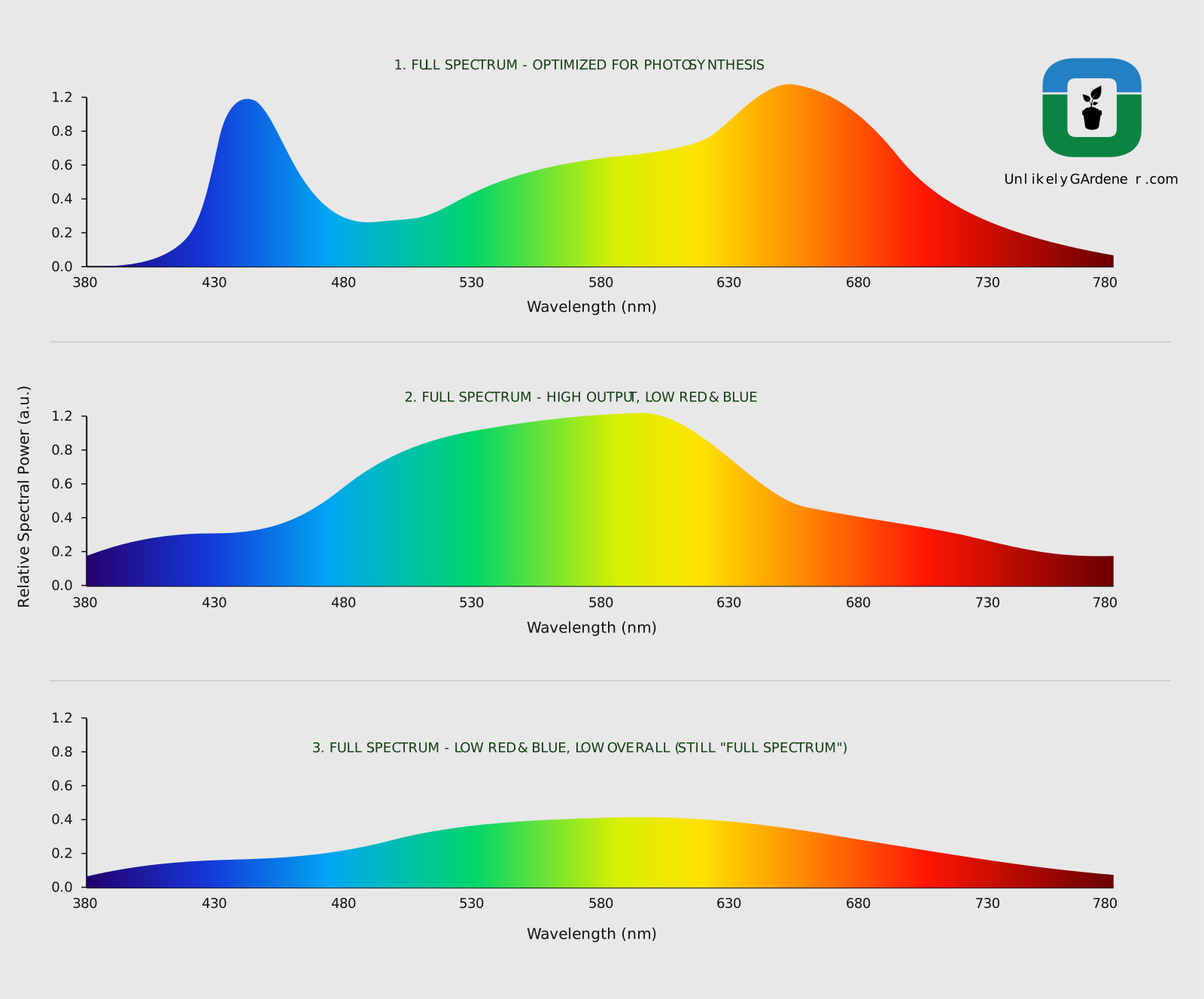
A usable chart shows meaningful output across the blue band (around 400 to 500nm) and the red band (around 600 to 700nm), the two regions where PAR response peaks. A chart with two narrow, tall spikes and almost nothing between them is a cheap red-and-blue diode array, not a full-spectrum light, regardless of what the packaging says. A chart with no visible structure at all, just a flat shaded block, isn’t real data. It’s a stock graphic dropped into a listing template.
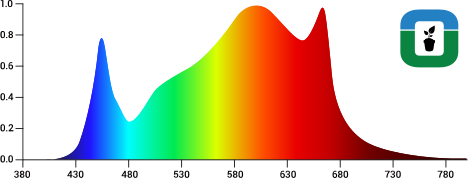
Nerd Corner: If the listing shows a graph but no axis labels or units, you can’t verify anything from it. A legitimate SPD chart always labels the x-axis in nanometres and the y-axis as relative or absolute intensity. No labels means no way to confirm the graph belongs to the actual product.
Does “Full Spectrum” Matter, and What Does It Mean?
Full spectrum is a real and useful thing, not marketing fluff on its own. Light across the full 400nm to 700nm range, including green and far-red wavelengths that narrow spectrum red-and-blue (blurple) lights skip, genuinely affects plant morphology through separate photoreceptor systems, blue wavelengths activating cryptochromes that shape leaf thickness and internode length, beyond whatever those same wavelengths contribute to raw photosynthetic rate. Plants grown under true full-spectrum light tend to develop more naturally than plants grown under a narrow two-colour spike.
The problem isn’t the concept. It’s that “full spectrum” has no enforced definition and no regulatory body checking who uses it accurately. Any light with a diode outside the red-blue range can legally print “full spectrum” on the box, whether that coverage is meaningful or a token sliver. The label is not evidence. The spectrum graph is the evidence, and only if it has labelled axes.
What Is Grow Light “Equivalency,” and Why Is It Inflated?
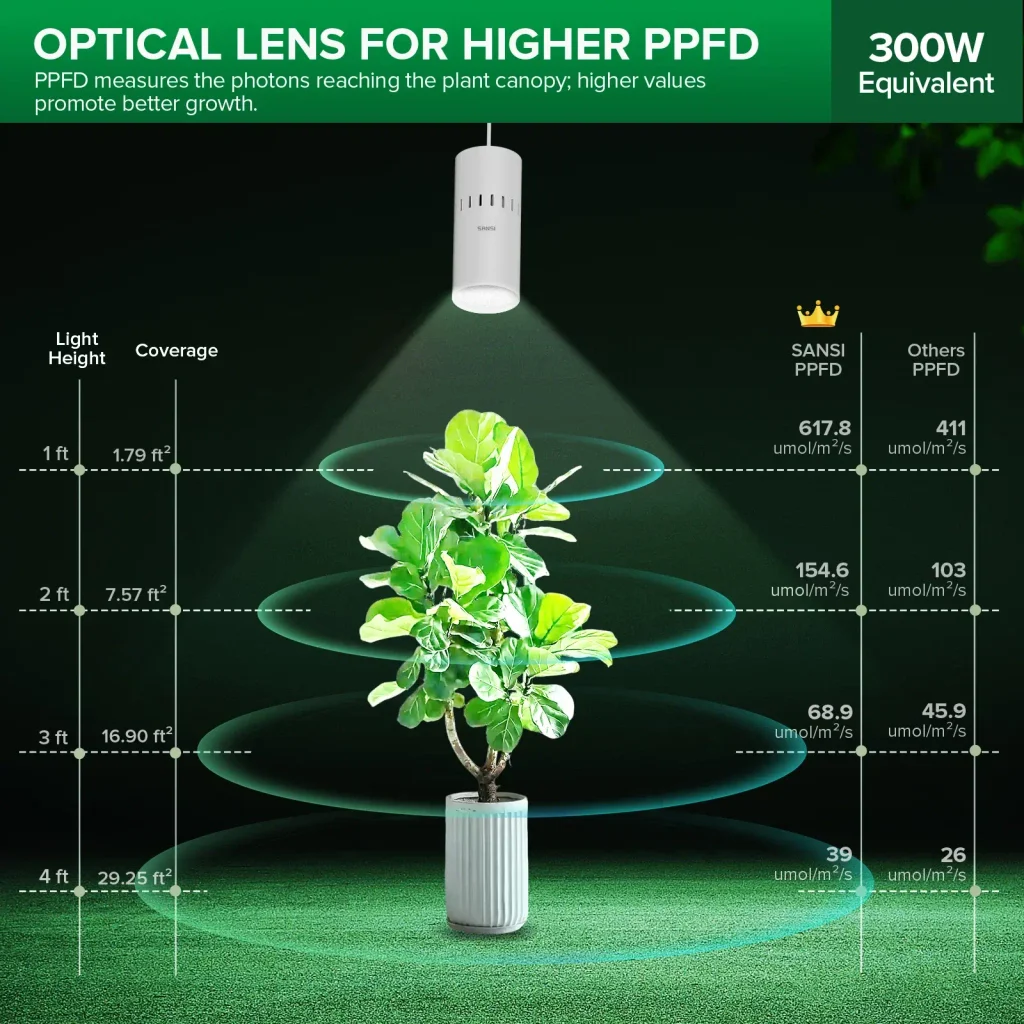
Equivalency claims, “60W equivalent,” “300W equivalent,” compare a modern LEDs to old incandescent bulbs based on how bright each looks to a human eye at similar wattage. That comparison standard was built for choosing a household lightbulb. It has no accepted horticultural meaning and no standardised test behind it for grow lights specifically.
An “equivalent to” number lets a Sansi 40-watt light (as shown – great light btw) advertise itself as a 300-watt equivalent, because the comparison is about visual brightness to a human, not photosynthetic output to a plant. Treat any equivalency claim as a number borrowed from a different industry to make a small light sound bigger than it is.
It’s like a salary quoted in pesos vs US dollars. The number you see looks impressive, but without an exchange rate, you have no way to know what you’re actually being offered. A grow light’s PPFD is the exchange rate. The equivalency figure is the foreign currency. Sansi lists the PPFD and coverage area at different hanging heights for added clarity. My only complaint is that they do not also publish a PAR map for added visual honesty and comparison
What Is µmol/J, and Why Don’t Sellers Advertise It?
Photosynthetic photon efficiency, expressed in µmol/J, measures how many usable photons a light produces per joule of electricity it consumes. It’s calculated by dividing total photon output by input wattage, and it’s the number that tells you whether a light is genuinely efficient or just drawing a lot of power to compensate for poor diode quality. Current high-performance horticultural LEDs reach roughly 2.5 to 3.5+ µmol/J.
A light with weak efficacy can still post a decent PPFD number simply by drawing more watts, at the cost of your electricity bill and often more heat near the canopy. Sellers rarely publish µmol/J because a low number invites the comparison they’d rather you not make. If a listing gives you wattage and PPFD but not efficacy, you can estimate it yourself: divide the PPF figure (if given) by the wattage. If neither PPF nor efficacy appears anywhere, that’s one more number missing from a spec sheet that should have it.
Why Is “Covers 2×4 Feet” a Meaningless Claim on Its Own?
Light intensity follows the inverse-square law: double the distance between a light and your plant, and the intensity landing on the leaf drops to roughly a quarter of what it was, not half. A coverage claim with no stated mounting height is a claim with no way to be checked.
Picture a drop of food colouring released into a glass of water. Right at the source, the colour is concentrated and vivid. Spread that same drop through a larger volume and it thins out fast, not proportionally, but sharply. Light behaves the same way as it spreads from a fixture. The photons a seller measured six inches from the diode are diluted long before they reach a plant sitting three feet away.
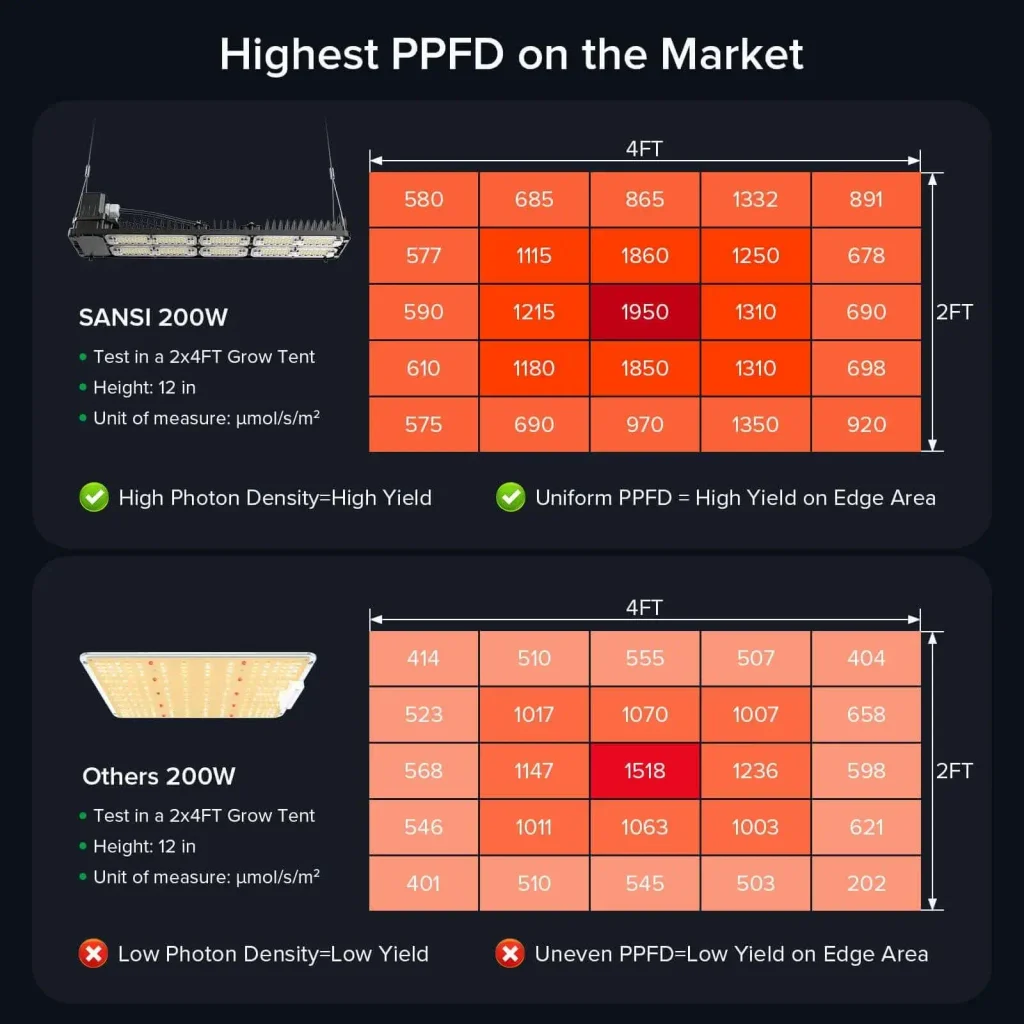
The gold standard here is a PAR map : a grid showing measured intensity across the claimed coverage area at a stated height, not just a single peak reading directly under the fixture. My breakdown of canopy light distribution covers why the centre-point number on a box is almost always higher than what your plant at the edge of that “coverage area” actually receives.
To put that falloff in concrete terms, take a look at the PAR map Sansi provides for its 200W panel light: a fixture reading 1,950 µmol/m²/s directly under its centre can drop to an average of roughly 795 µmol/m²/s around the outer edges of the coverage area, a drop of 59% over a distance of only 1 to 2 feet. The comparative product’s PAR map shows a drop from 1,518 µmol/m²/s under the centre to an average of roughly 535 µmol/m²/s, a decrease of about 65%.
Both maps show similar decreases in light intensity, with Sansi producing more light and losing less of it over the illumination target. This type of transparent product reporting lets you see actual light degradation across the same area. That’s far more helpful than seeing only the peak intensity number from the single best spot, which is what most manufacturers publish to make their products seem better than they actually are.
Pro Tip: Before buying, ask the seller directly for the PPFD reading at the specific height you plan to mount the light. A reputable seller can answer immediately, because they measured it. A seller who can’t, or who deflects to the coverage-area claim again, doesn’t have the data behind their own listing.
Why Do Typos, Mismatched Photos, and AI-Generated Images Matter on a Listing?
None of these prove a product is bad on their own, we all are flawed and able to make mistakes, especially me (just ask my wife). Together, they’re a pattern worth noting, however.
The devil is in the details. Typos and garbled copy in a product description are a signal, not proof, but they correlate with rushed, low-investment listings, and a listing thrown together in an hour rarely comes from a seller who spent real time testing the product behind it. Watch for spec numbers that contradict each other within the same listing: a title claiming one wattage while the bullet points state another, or a PPFD figure that shifts between the product description and the technical specifications tab. A seller who can’t keep their own numbers straight across three sections of one listing has no reliable numbers at all.
Mismatched photos tell the same story from a different angle. A caption naming one wattage while the product title lists another, or product photos showing a different shape, colour, or LED layout than what the listing describes, all point to a seller who didn’t bother producing real photography for their own product. If nobody invested the effort to photograph the actual unit accurately, there’s little reason to assume anybody invested the effort to measure its actual output either.
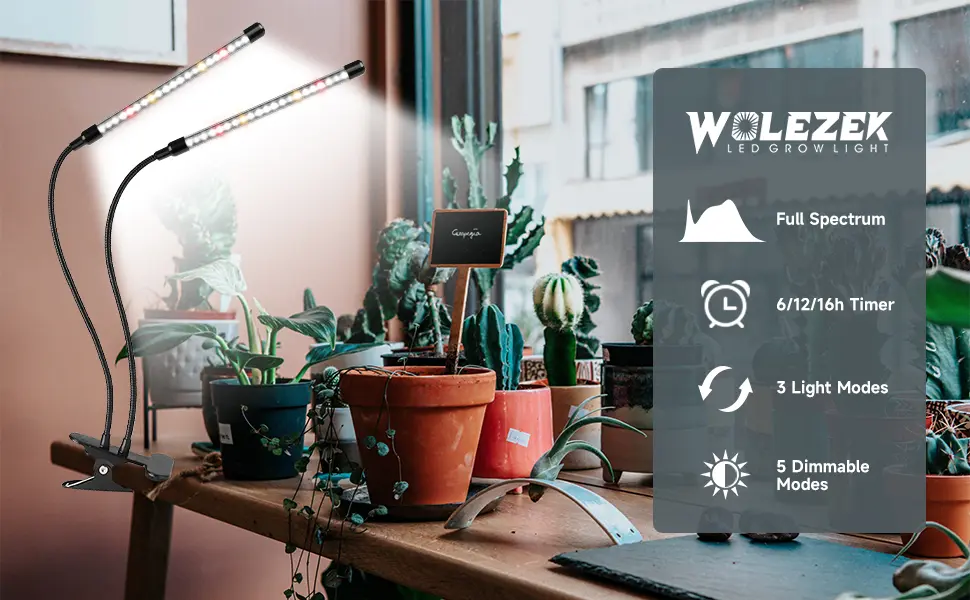
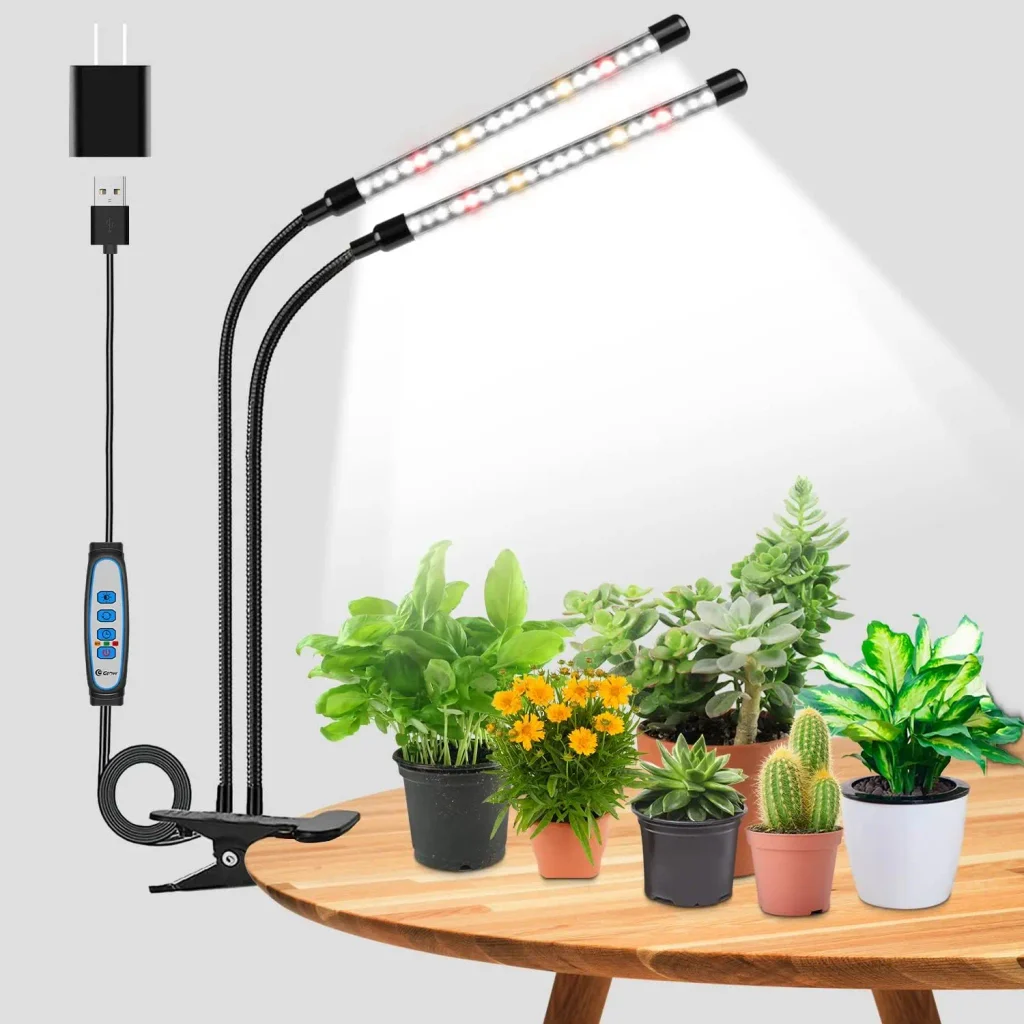
AI-generated or poorly Photoshopped product images are the latest version of the same tell, and they’re worth learning to spot specifically. Watch for shadows falling in weird directions across the same image, pixelated fringe, reflections that don’t match, text on the unit itself that’s warped, doubled, or nonsensical, cords or plugs with extra or malformed prongs, and plant leaves with impossible symmetry or scale that doesn’t follow real world sizing. A “PAR map” graphic that shows even light intensity across the target vs numbers from an actual test that will drop off dramatically from the center to the edge. It isn’t real data if nobody ever measured it.
Is USB Power a Red Flag on a Grow Light?
Not automatically, but it caps what a light can honestly claim. Standard USB 2.0 delivers 5V at up to 500mA, about 2.5W. USB 3.0 pushes that to roughly 4.5W. Only USB-C with Power Delivery can deliver higher wattages, and only when both the light and the power source explicitly support that level of output.
Most USB grow lights sit in the 5-watt to 10-watt range. That’s enough for a seedling tray or a single low-light plant a few inches away. It is not enough to be claiming multi-foot coverage or flowering-stage intensity. If a listing shows “5V” as the input voltage and a wattage claim well beyond what standard USB can deliver, with no mention of Power Delivery abilities anywhere in the description, the numbers on that listing don’t agree with each other. That’s not a nitpick. It’s a listing containing two claims that can’t both be true.
When Do Dimming and Timers Actually Matter?
Unlike most of the features on this list, dimming and built-in timers are worth paying for. This is the one section here that isn’t a warning.
A dimmer lets you adjust intensity without re-mounting the fixture at a different height, useful as a plant moves through seedling, vegetative, and mature stages with different light needs. A built-in timer automates a consistent daily photoperiod, which matters because total daily light depends on both intensity and duration together. My guide to daily light integral covers why an inconsistent on-off schedule undermines even a genuinely good PPFD number.
Neither feature fixes a light with poor spectrum or weak output. But on a light that already checks out on the numbers above, dimming and timers are functional upgrades, not padding. A lot of low quality grow lights add these features to make their products seem “feature rich,” but in reality it’s like polishing a turd or going through the effort of putting lipstick on a pig.
How Do You Read Grow Light Reviews Without Getting Fooled?
Rating manipulation on Amazon is not a fringe concern. A 2022 study published in Marketing Science tracked products actively buying fake reviews through private social media groups and found that manipulation produced a measurable, if temporary, boost in ratings and sales before roughly half of the fraudulent reviews were eventually removed, an average of over 100 days later. The delay is long enough for a bad grow light to accumulate a misleadingly strong rating well before enforcement catches up.
Stat: In that study, sellers who purchased fake reviews saw roughly half of them eventually deleted by Amazon, but only after a lag averaging more than 100 days, long enough for the manipulated rating to do its job.
The ‘Verified Purchase’ badge helps against some manipulation tactics, but fake reviews remain widespread regardless; separate peer-reviewed research on detecting fake-review buyers found the practice so entrenched that it built a detection method around it, identifying manipulated products by how tightly clustered their reviewers were with other manipulated products, rather than relying on the reviews’ content or badges at all. It works the same way a restaurant paying for glowing write-ups would: the food doesn’t improve, only the appearance of consensus does.
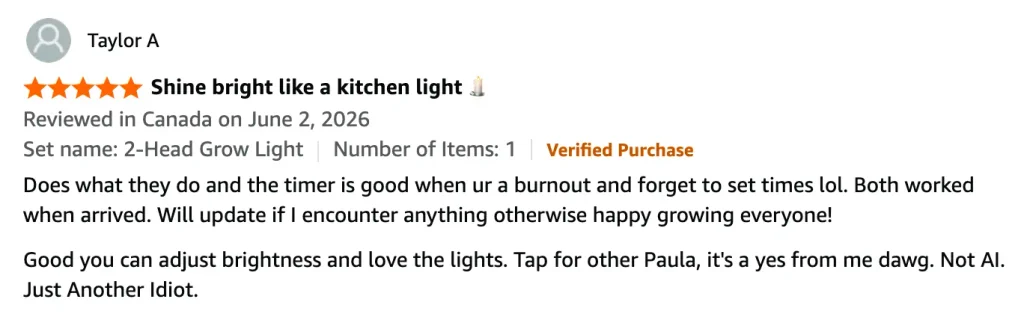
Fake reviews are only half of the problem. Genuine, honestly-left five-star reviews carry a separate limitation: most reviewers have no way to evaluate horticultural lighting performance in the first place, because the physics behind it is invisible to the naked eye. A reviewer can report whether a light powered on, whether the timer worked, and whether their plant looked different weeks later. None of that is a PPFD reading, a spectrum measurement, or an efficacy figure. Scroll through review after genuine review on a bestselling grow light and the vocabulary this article just walked you through, PPFD, spectrum graph, µmol/J, essentially never appears. Reviewers report brightness, convenience, and vibes, because that’s the only data available to someone without a light meter.
That opinion gap matters because buying a grow light almost always comes bundled with paying closer attention to the plant it’s aimed at: more consistent watering, a better spot, a fresh look at something that had been neglected. A reviewer reporting thriving growth weeks after installing a new light is describing a real observation, but rarely isolates the light as the only care variable that changed. One widely-reviewed bestseller includes a review from a buyer who admits to running the wrong spectrum setting for months without realising a correct one existed, then switching settings and reporting a growth spurt within days, while rating the product five stars the entire time, both before the switch and after. The rating never moved. The buyer’s understanding of what the product was actually doing did.
Myth Check: A five-star rating is proof someone was satisfied with what they could see. It is not proof the light delivers what a spectrum graph or a PPFD reading would confirm.
Weigh reviews accordingly, and for two different problems. For catching manipulation, look for photo reviews showing actual plant growth over weeks or months rather than an unboxing shot from delivery day, and be suspicious of a rating distribution that’s almost entirely five-star with no three-star middle ground; real products accumulate some mixed, mundane feedback. For genuine reviews, use them to catch functional failures, a stand that won’t hold steady, a timer that resets itself, a unit that stops turning on, since those are things any buyer can observe accurately. Don’t use them to confirm photosynthetic performance. A star rating was never built to measure that, and “my plants love it” tells you about as much as a car review that only mentions the engine sounds nice.
Why Does Buying an Ineffective Grow Light Still Feel Like a Good Decision?
A grow light doesn’t need to work well to make its owner happy with it. In researching about 200 lights from grow light brands worth calling garbage, the same five benefits kept surfacing across reviews and marketing copy, regardless of whether the light itself delivered anything close to what a plant needs. Each one maps to a well-documented psychological pattern that rewards the purchase independent of performance.
Why a Mediocre Grow Light Still Earns a Five-Star Rating
| Product Benefit | Psychological Driver | Why It Matters |
|---|---|---|
| Plants grow visibly better | Confirmation bias, post-purchase rationalization | A visible improvement, real or coincidental, gets credited entirely to the light. Confirmation bias makes an owner notice and remember the change while filtering out everything else that shifted at the same time, and post-purchase rationalization pushes the owner to interpret ambiguous results in the light’s favour, since doing otherwise means admitting the money was wasted. |
| Fast, set-and-forget timer | Cognitive ease, status quo bias | Once the timer is programmed, the light asks nothing further of its owner. Low ongoing effort keeps satisfaction high, and switching to a better light starts to feel like unnecessary work, even when the current one is mediocre. |
| Adjustable brightness and spectrum settings | Illusion of control, IKEA effect | Dials and settings create a sense of control over the outcome, whether or not they’re ever used correctly, or used at all. Research on the IKEA effect shows that involvement in customising a product increases how much a person values it, independent of the product’s actual performance. |
| Compact, fits anywhere | Processing fluency | A product that’s simple to place and use gets judged more favourably overall. Ease of experience is a well-documented stand-in for quality, even when the two have nothing to do with each other. |
| Cheap with easy setup | Anchoring | A low price sets a low bar for what counts as success. Anchoring means buyers judge the outcome against what they paid, so “the plant didn’t die” clears the bar an inexpensive light set for itself, even when a properly specified light would have delivered visibly more. |
None of this makes the light better. It makes the owner more satisfied with it, which is a different measurement entirely. Satisfaction is what a five-star review reports. Performance is what a PPFD reading confirms. Every check earlier in this article exists to answer the second question, because the first one was never in doubt: most buyers end up satisfied with most purchases, whether or not the product did anything special.
What a Legitimate Grow Light Listing Actually Looks Like
Put the checks above together and the difference between a trustworthy listing and a marketing wrapper becomes easy to spot at a glance.
Legitimate Listing vs. Red-Flag Listing
| Spec Sheet Element | Legitimate Listing | Red-Flag Listing |
|---|---|---|
| Output metric | PPFD stated with a specific mounting distance | Watts or lumens/Lux only, no/vague PPFD data |
| Spectrum claim | Labelled SPD graph with nanometre axis | “Full spectrum” text with no graph, or an unlabelled graphic |
| Coverage claim | PAR map showing intensity across the stated area | “Covers 2×4 feet” with no height or map given |
| Efficiency | µmol/J and/or PPF with wattage so you can calculate it | Neither figure present |
| Product photos | Consistent shadows, matching captions, real unit shown | Mismatched wattage in captions, warped text, generic stock plants |
| Reviews | Mixed ratings, growth photos over time | Near-uniform five-star, unboxing photos only |
Before buying, ask a seller two things directly: what PPFD does this deliver at the height I’ll actually mount it, and what’s the µmol/J efficacy. A seller with real data answers both without hesitation. A seller without it redirects to wattage and coverage claims, which is exactly the numbers this article just walked you through.
Frequently Asked Questions
The Unlikely Gardener
Sources & Further Reading
- McCree, K.J. (1971). The action spectrum, absorptance and quantum yield of photosynthesis in crop plants. Agricultural Meteorology, 9, 191-216. https://doi.org/10.1016/0002-1571(71)90022-7
- He, S., Hollenbeck, B., & Proserpio, D. (2022). The Market for Fake Reviews. Marketing Science, 41(5), 896-921. https://doi.org/10.1287/mksc.2022.1353
- He, S., Hollenbeck, B., Overgoor, G., Proserpio, D., & Tosyali, A. (2022). Detecting fake-review buyers using network structure: Direct evidence from Amazon. PNAS, 119(47), e2211932119. https://doi.org/10.1073/pnas.2211932119
- Nickerson, R.S. (1998). Confirmation bias: A ubiquitous phenomenon in many guises. Review of General Psychology, 2(2), 175-220. https://doi.org/10.1037/1089-2680.2.2.175
- Festinger, L. (1957). A Theory of Cognitive Dissonance. Stanford University Press. https://doi.org/10.1515/9781503620766
- Norton, M.I., Mochon, D., & Ariely, D. (2012). The IKEA effect: When labor leads to love. Journal of Consumer Psychology, 22(3), 453-460. https://doi.org/10.1016/j.jcps.2011.08.002
- Edison Opto. What are Plant Grow Lights? The Science Behind LED Spectrum, PAR, and PPFD. https://www.edison-opto.com/news/articles/what-is-a-plant-grow-light
- Edison Opto. What Full Spectrum LED Plant Grow Lights Do at Every Plant Growth Stage. https://www.edison-opto.com/news/articles/full-spectrum-LED-grow-lights-do
- Tversky, A., & Kahneman, D. (1974). Judgment under uncertainty: Heuristics and biases. Science, 185(4157), 1124-1131. https://doi.org/10.1126/science.185.4157.1124
UG related reading: Understanding Light Spectrum on Plant Growth and The Nine Cardinal Parameters for how light fits into the rest of your plant’s care.
Disclosure: This article used AI to assist with surfacing up-to-date, appropriate research, organization, and copy editing, much like traditional publishing uses editorial tools and staff. All information is verified against peer-reviewed evidence by a human before publishing. AI-generated images may also be used to illustrate concepts and add visual interest, never to represent them as photographic evidence or to fabricate observations, results, or real-world events. Read my full AI disclosure for more information.

The Unlikely Gardener
aka, Kyle Bailey
Kyle Bailey is the founder of UnlikelyGardener.com, where science meets soil. He also runs the wildly popular Facebook community
Plant Hoarders Anonymous (PHA), home to ~418,000 plant lovers sharing real talk and real results, as well as more than 13,000 followers of his Facebook alter-ego, The Unlikely Gardener.When Kyle’s not knee-deep in horticultural research or myth-busting bad plant advice, he’s leading two marketing agencies—
City Sidewalk Marketing, which supports local small businesses, and
Blue Square Marketing, focused on the skilled trades.He’s also a proud dad, grandfather (affectionately referred to as Grumpy), and a dog daddy to three pit bull mix rescues—including one 165-pound lap dog who hasn’t gotten the memo.
Life is busy. Give Us Your Name & Email and We'll Send You Content.

