


The invisible line between survival, stagnation, and real growth
Time: 10 - 13 minutes (2896 words)
Published: January 14, 2026
Most houseplants don't die from bad care, they stall.
They sit in the same pot for years, pushing out the occasional leaf, shedding another, and slowly teaching their owner that "this is just how this plant grows indoors." It's easy to accept that story, especially when the plant is still technically alive.
But survival is not growth, and longevity is not proof that conditions are good.
Plants grow only when they can afford to. That affordability is determined by carbon, and carbon is controlled almost entirely by light. Until a plant receives enough light to consistently run a surplus, everything else we do is maintenance at best and distraction at worst.
This Unlikely Gardener article is about that minimum line. The point where a plant stops surviving and begins to truly thrive.
Let’s Get You Up to Speed
This UG article will help you understand:
- Why living and growing are different physiological states for plants
- What a positive carbon situation actually means indoors
- Why light intensity matters more than most people realise
- How low light forces plants to quietly dismantle themselves
- Why fertilizer and “care improvements” often fail to help
This idea underpins how The Unlikely Gardener evaluates plant health, plant profiles, and care advice. If light isn’t addressed first, nothing else is reliable.
Got Things to Do? This is For You!
Plants need a minimum level of usable light to grow, not just to stay alive. When light falls below that threshold, plants don’t immediately fail, but they do shift into survival mode, relying on stored energy rather than producing new carbon. In this state, water and fertilizer can’t correct the underlying deficit, because the plant simply doesn’t have the energy to use them. This is why so many indoor plants linger for years without meaningful progress, and why what looks like success in low light is often just a temporary borrowing of energy rather than true, sustained growth.
Table of Contents
Survival Feels Like Success Until You Know What to Look For
One of the trickiest parts of indoor plant care is that failure is rarely dramatic. A plant underfed by light doesn’t usually collapse overnight. It usually adjusts over weeks and months.
Leaves get thinner. Growth slows. Roots become less ambitious. Older foliage disappears one leaf at a time, often blamed on age or “normal growth cycles.” Because none of this looks urgent, it gets interpreted as typical and thus acceptable.
But plants don’t need to be growing to stay alive.
They can exist for long periods in a holding pattern, matching their structure to the energy coming in. Indoors, that often means shrinking quietly rather than expanding visibly. Once you notice it, this pattern is hard to unsee. The plant isn’t progressing. It’s budgeting.
Pro Tip: If a plant looks stable but never improves, it’s usually not a care mistake. It’s a light constraint.
Carbon Is the Real Currency of Growth
Everything a plant builds comes from carbon. Leaves, roots, stems, defensive compounds, even the energy required to move water all depend on carbon fixed through photosynthesis.
At the same time, plants are constantly burning carbon through respiration. This doesn’t stop at night. It doesn’t pause in winter. Respiration is the cost of staying alive.
Growth only happens when carbon income exceeds carbon expenses.
When income and expenses balance, the plant survives.
When expenses exceed income, the plant starts selling assets.
This is why light matters so much more than it’s usually treated. Light is the only input that directly controls carbon income. Water, nutrients, and humidity all support growth, but only after the plant can afford them.
The Light Compensation Point: Where Survival Begins
Plants have a threshold where photosynthesis just barely covers respiration. In plant physiology, this is called the light compensation point. Below it, the plant loses carbon with every hour that passes. Above it, the bleeding stops.
But stopping the loss is not the same as growing.
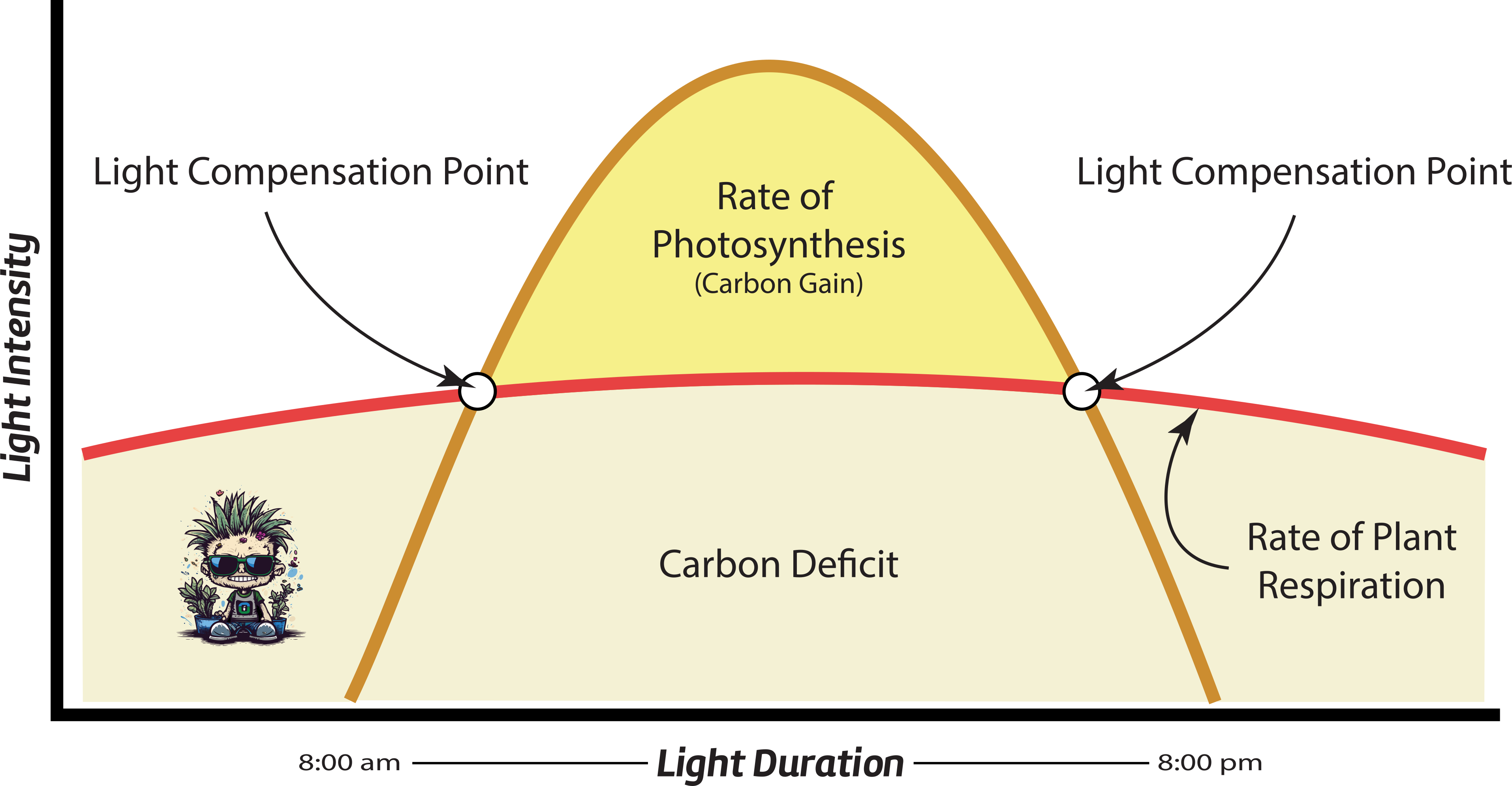
Real growth requires margin. It requires a consistent buffer where carbon gain is comfortably higher than carbon loss over the course of the day. Indoors, many plants hover just above their compensation point, never crossing into meaningful surplus.
This is why a plant can look stable for years without improving. It’s not failing. It simply never gets enough light to justify expansion.
Compensation Points Are Not Fixed
The light level a plant needs to break even isn’t a universal constant. It shifts.
Temperature plays a larger role than most unlikely gardeners realise. Respiration accelerates as temperatures rise. A plant in a warm room burns more carbon overnight than the same plant kept cooler. This means the compensation point climbs with temperature. A window that sustains a plant through winter may quietly starve it in summer, even though the light hasn’t changed.
Species matters too. Plants native to deep shade have evolved lower respiration rates and can break even at lower light levels. Some Calathea, many ferns, and other understory plants can often operate on less light. Plants from brighter habitats carry higher metabolic costs and need more light just to hold position.
And acclimation shifts the target over time. A plant kept in low light gradually reduces its respiration by building thinner leaves and scaling back maintenance costs. This is how it stretches survival longer than expected. But the same adaptation leaves it poorly equipped if conditions suddenly improve. Acclimation is a trade, not a solution.
FYI: Acclimation helps plants survive longer in low light, but it almost always lowers their ceiling for future growth.
Why Light Intensity Can’t Be Averaged Away
Daily light energy matters, but only after intensity requirements are met.
Photosynthesis responds to the strength of light hitting the leaf at any given moment. Long hours of dim light don’t fully compensate for insufficient intensity. A plant doesn’t really experience light as a daily average. It experiences it locally, on a leaf by leaf basis, minute by minute.
This is why brief bright periods near a window rarely undo long stretches of dim indoor light. It’s also why many plants appear to “perk up” temporarily but never build lasting strength.
The machinery of photosynthesis needs enough ongoing photon pressure to operate efficiently. Without it, time alone doesn’t solve the problem.
General Light Ranges and What They Actually Allow
Rather than pretending every plant behaves the same, the Unlikely Gardener (me) looks at light in functional ranges tied to carbon balance. These thresholds apply broadly to tropical foliage plants, and other species, though species with unusually low or high compensation points will shift accordingly.
Below roughly 50 to 75 µmol/m²/s, most tropical foliage plants, even low light ones, are in survival mode. Photosynthesis may occur, but not enough to consistently offset respiration. New growth here is usually funded by stored reserves.
Between 75 and 150 µmol/m²/s, some plants can occasionally edge into surplus during peak hours. Growth is possible but fragile. Stress tolerance is low, recovery is slow, and progress is inconsistent.
Between 150 and 300 µmol/m²/s, most common indoor tropical plants can maintain a reliable positive carbon balance in this range. Leaves thicken, roots function better, and the plant begins behaving like it has options.
Above 300 µmol/m²/s, carbon surplus is stronger across many indoor plants, assuming other constraints are addressed. Growth accelerates, but so do water use and nutrient demand. Eventually, returns diminish as the photosynthetic machinery approaches saturation, but few indoor environments push past that ceiling.
These ranges are not promises. They are thresholds of possibility. They explain why plants behave the way they do long before symptoms appear.
Why DLI Alone Can Be Misleading Indoors
Daily Light Integral becomes useful only after intensity crosses the compensation point. Below that threshold, every hour of dim light is net-negative. The plant respires more than it fixes. Extending the photoperiod doesn’t dig the plant out of a hole. It keeps the plant in the hole longer.
This is why a room that receives light all day can still underfeed a plant. Accumulating sub-threshold light doesn’t produce the same outcome as fewer hours of stronger light.
Indoors, respiration runs continuously while light is often marginal. A plant can technically receive light (natural or artificial) every day and still never reach a net positive carbon position.
This is also why windows that feel bright to us can still fail plants. Human eyes and plant physiology are responding to different things across the light spectrum and intensity.
What Plants Give Up When Light Is Limited
Energy limitation forces a plant to make tradeoffs, and those tradeoffs almost always show up as changes in physiological structure rather than sudden collapse. Older or variegated leaves are shed through leaf senescence because they cost more to maintain than they return. New leaves are built thinner because thinner leaf tissue requires less carbon to produce and less energy to keep alive. Under low light, plants often reduce root mass, not because of pot size, but because roots are costly tissue that can’t be maintained without sufficient carbon.
Even defensive chemistry declines, because producing protective compounds is a luxury when energy is tight. Many of the chemicals plants rely on to deter pests, suppress pathogens, or reinforce cell walls require a steady carbon supply to produce and maintain. When carbon is limited, those investments get scaled back. The plant prioritises basic survival over protection, leaving tissues less defended and more vulnerable to opportunistic pests and disease. This is why plants under chronic low light often seem to attract problems regularly or that they never had before. It isn’t bad luck, and it isn’t coincidence. It’s the predictable result of a plant reallocating energy away from defence in order to stay alive.
To the plant parent, these shifts often appear as familiar problems. Leaves yellow or fade, a classic sign of chlorosis. Growth slows or stalls. The plant becomes more sensitive to watering mistakes, pests, or minor environmental changes. Because these symptoms resemble nutrient deficiencies or hydration issues, they’re frequently misdiagnosed as care failures rather than what they really are: the visible consequences of long-term carbon limitation.
What’s important to understand is that none of this reflects weakness or fragility. The plant isn’t failing. It’s adapting as efficiently as it can to the conditions it’s been given. These are strategic responses, not errors.
The plant is not weak, it’s constrained by a lack of available energy.
Why Fertilizer Rarely Helps in Low Light
Nutrients do not create growth by themselves. They are the raw materials plants use after growth is made possible by adequate light. Without enough light, those building blocks have nowhere to go.
In low light, transpiration drops. Less water moves through the plant via the xylem , and when water flow slows, nutrient uptake slows right along with it. Adding more fertilizer under these conditions does not boost growth. Instead, nutrients begin to accumulate in the root zone, increasing the risk of fertilizer burn.
The first tissues to suffer are often root hairs and feeder roots, the parts responsible for most water absorption. When those are damaged, water uptake slows even further, and the risk of root rot rises. What looks like a nutrient problem quickly turns into a root health problem.
This is why feeding plants in low light so often leads to salt buildup, root stress, and frustration. The plant is not hungry. It is underpowered. You see people recommend fertilizer all the time, but the real limitation is usually light, not nutrients.
Why “Low Light Plants” Still Struggle to Grow Indoors
Plants described as low light tolerant aren’t plants that grow well in low light. They’re plants that can tolerate a carbon deficit longer than others before the consequences become obvious. In practical terms, they’re better at surviving under poor energy conditions, not better at building new tissue there.
Some of this tolerance is real. Shade-adapted species tend to carry lower respiratory costs and can break even at light levels that would push sun-adapted plants into rapid decline. They lose carbon more slowly. That allows them to hold their structure longer, shed leaves more gradually, and avoid the dramatic failure that makes problems easy to spot. But even these plants are not thriving in the dark. They’re operating close to neutral, investing just enough energy to stay intact, not enough to improve.
This is where the misunderstanding takes hold. Because these plants don’t crash, it’s easy to assume they’re doing fine. But tolerance is not preference, and survival is not success. A plant that can endure low light is still constrained by it, and the signs of that constraint often show up as thin leaves, stalled growth, and heightened sensitivity to stress rather than outright death.
That distinction matters because it explains what so many people observe but struggle to interpret. When light improves, these same plants often look dramatically better in a short period of time. It’s not because the plant has suddenly become easier or more forgiving. It’s because the energy math has changed. The plant hasn’t changed. Its light budget has.
How Plant Marketing Exploits Low-Light Conditions
Commercial growers and nurseries know that light deficits take time to manifest. They know that when people don't see sustained growth, or when observable problems finally manifest, they have probably already made a number of adjustments that mask underlying light problems.
Because plants take time to fail in low light environments, fertile ground is created for misleading marketing tactics to be used to sell more product. Because a plant survives long-enough, but without truly thriving, it creates just enough ambiguity for misleading narratives to slip in. Well meaning consumers usually fuel the fire by repeating a variety of things they've been told that will help.
Look at almost any post in the PHA, or other plant groups. We are often our own worst enemies. We're killing our plants by offering help when the basics of what a plant most often needs is rarely brought up.
Adequate Light - "But lights are expensive!"
Plant care “improvements” are almost always suggested, and almost always come with an added cost. Repotting into a “chunky” grow mix has become default advice, often paired with recommendations for overpriced soil products that cost far more than a basic peat or coir mix made from simple ingredients. Watering methods turn into products, from bottom-watering routines boosted with miracle liquids to expensive self-watering pots that promise to double oxygen availability at the roots. Premium fertilizers are pitched as the missing piece needed to unlock full growth potential, while a steady stream of accessories fills every remaining gap in the market.
Because the plant doesn’t fail outright, the real limitation stays hidden. Any real or imagined improvement gets credited to the latest thing that was added, even when nothing fundamental has changed. Each intervention costs money, feels productive, and reinforces the belief that progress is being made. But in most cases, none of it increases carbon gain. Without an energy surplus driven by adequate light, these changes don’t initiate growth. They simply rearrange the conditions around a plant that is still operating under the same constraint.
Why Light Determines Whether Plants Grow or Stall
Light isn’t one care factor among many. It’s the gatekeeper.
Until a plant receives enough light to consistently run a carbon surplus, growth and plant health is at risk. What seems like progress is most often borrowed energy. What looks like stability and consistency is imperceptible delayed decline. No amount of watering maintenance, fancy grow mix recipes, or bougie fertilizer changes the energy fundamentals.
Plants don’t fail quietly in low light. They adapt quietly, trimming costs, shedding tissue, and lowering expectations. The result often looks manageable, even normal, until the plant hits a point of no return. Quite frequently that can take months. Often plants can hover at the border between carbon gain and carbon loss and survive, providing a feeling of accomplishment until some environmental tips the balance and causes rapid decline. That kind of event is often followed with the question, "What happened, it's been cared for the same way for years and then all of a sudden..."
When a plant struggles from various challenges under low light, it isn’t being difficult. It’s being precise.
At the very least measure your light and ensure that the light compensation point is being met. It won't guarantee success will follow, but everything will be more easily managed and dealt with if the plant is getting the light it needs for carbon gain.
Good luck out there!
Disclosure: This article used AI to assist with surfacing up-to-date, appropriate research, organization, and copy editing, much like traditional publishing uses editorial tools and staff. All information is verified against peer-reviewed evidence by a human before publishing. AI-generated images may also be used to illustrate concepts and add visual interest, never to represent them as photographic evidence or to fabricate observations, results, or real-world events. Read my full AI disclosure for more information.

The Unlikely Gardener
aka, Kyle Bailey
Kyle Bailey is the founder of UnlikelyGardener.com, where science meets soil. He also runs the wildly popular Facebook community
Plant Hoarders Anonymous (PHA), home to ~418,000 plant lovers sharing real talk and real results, as well as more than 13,000 followers of his Facebook alter-ego, The Unlikely Gardener.When Kyle’s not knee-deep in horticultural research or myth-busting bad plant advice, he’s leading two marketing agencies—
City Sidewalk Marketing, which supports local small businesses, and
Blue Square Marketing, focused on the skilled trades.He’s also a proud dad, grandfather (affectionately referred to as Grumpy), and a dog daddy to three pit bull mix rescues—including one 165-pound lap dog who hasn’t gotten the memo.
Life is busy. Give Us Your Name & Email and We'll Send You Content.

This was a hard read about light deficiency and for a regular grower of indoor plants I have know idea if I’m doing anything right?!
GREAT CONTENT!!! THANK YOU