

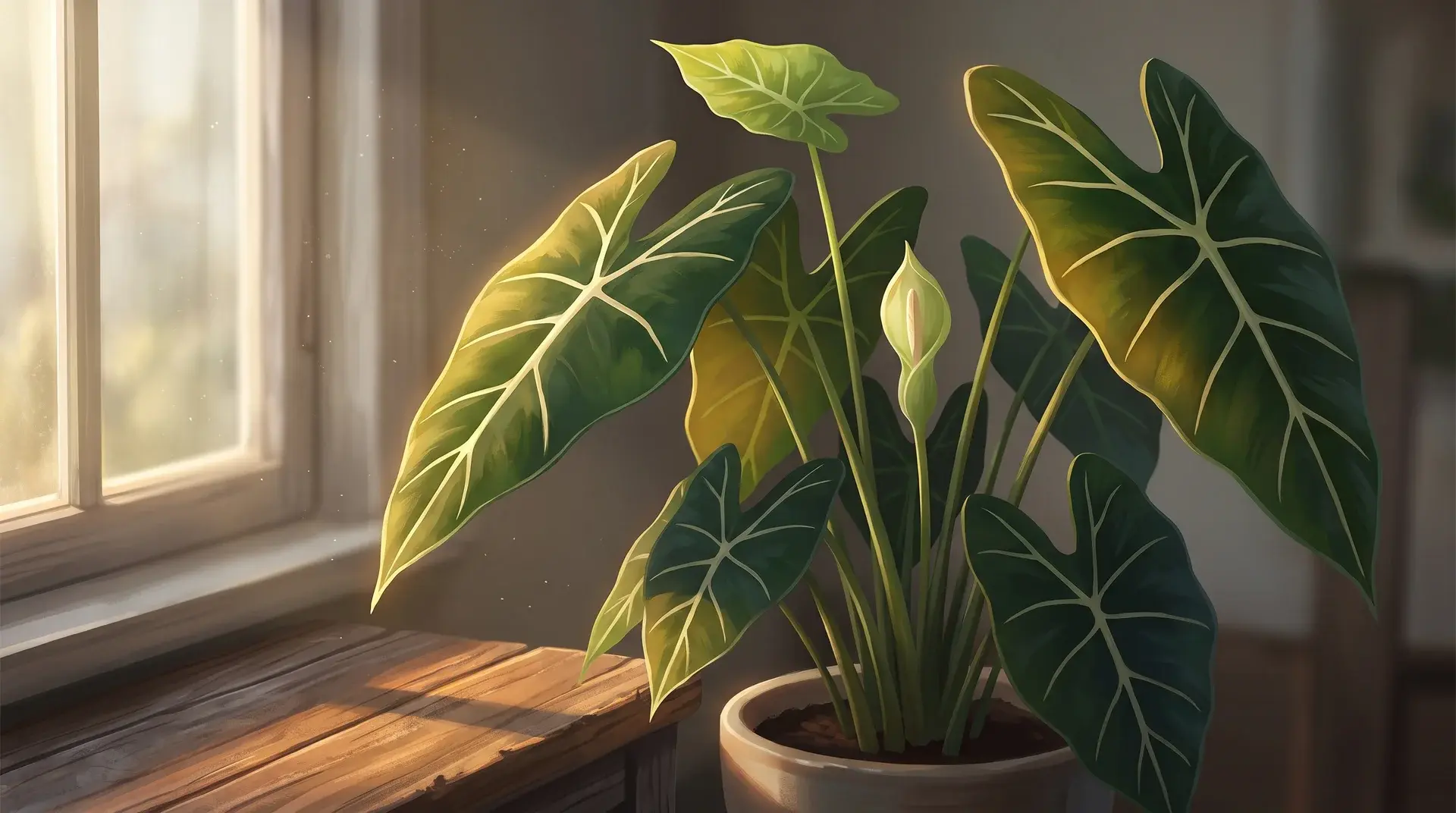
An Inflorescence means your plant had energy to spare. Your newest leaf shows if it still does.
Time: 11 - 14 minutes (3161 words)
Published: November 12, 2026
Category:
A pale, hooded bud emerges from your Alocasia, and you can’t help feeling a little proud. Your plant is flowering, so surely you’ve finally nailed the right combination of light, water, and growing medium.
But look online and you’ll find a darker explanation. Apparently, by some opinions, your Alocasia thinks it’s dying and is making one last desperate attempt to reproduce before it bites the dust.
I’ll admit, I used to believe that one myself and repeated it as advice more than a few times. It sounds plausible, but when I started digging into the research, the evidence told a different story. And as I’ve said before, the evidence wins, regardless of what any of us might have believed.
Neither explanation holds up particularly well. Both assume flowering tells us something about the plant’s current health, when much of the process actually began weeks or even months earlier.
An Alocasia flower isn’t necessarily telling you how your plant is doing today. It’s giving you a glimpse into its past.
Let’s Get You Up to Speed
This article will help you understand:
- Why a bloom proves your Alocasia was mature and well lit at some point, and says nothing about what’s happening now
- Why the “dying plant trying to reproduce” story doesn’t fit Alocasia, even though stress-triggered flowering is real
- What a flower actually costs, including a spadix that can heat itself more than 25 °C above the air around it
- How likely cutting the flower is to help or hurt, and the one condition that decides it
- How to read your plant’s real condition from its newest leaf instead of its flower
Got Things to Do? This is For You!
A flowering Alocasia isn’t proof your care is working. It’s proof the plant was mature and had energy saved up, and the flower is spending those savings.
On window light, those savings are hard to rebuild. An Alocasia needs a daily light integral (DLI, the total light it collects in a day) of 13 to 22 mol/m²/day to grow, and a south-facing window in a northern winter gives it 1 to 4, rarely more than 5. The flower isn’t cheap, either. In wild giant taro, the spadix heats itself to an average peak of 43.9 °C (111 °F) for about a day and a half, burning stored sugars to do it. And the “it’s dying and trying to reproduce” story doesn’t hold up. A starving plant can’t afford a flower, and while stress-triggered flowering is documented in nearly 20 plant species, nobody has shown it in Alocasia.
Cutting the flower as a bud sometimes protects the next leaves and rarely does harm, so cut it if your plant lives on window light alone. Under a grow light strong enough for active growth, the plant can afford the bloom, and keeping it is your call. Either way, judge your plant by its newest leaf. If each one is smaller than the last, cut the bud and fix the light.
Let’s dig in!
Table of Contents
The Story Everyone Tells About a Flowering Alocasia
Post a photo of a flowering Alocasia in most any plant group and the replies arrive within minutes. “It’s happy.” “You’re doing everything right.” “Mine has never bloomed, what’s your secret?”
It sounds reasonable. Across most of the gardening world, flowers are the goal. Roses, tomatoes, and orchids are all judged by what they produce, so a bloom reads as part of that success process.
The darker version shows up nearly as often. An inflorescence is a last-ditch attempt to save itself. The plant senses it’s in trouble, so it pours itself into self-propagation to save its genes before it goes full crispy and joins the compost pile.
Both stories make the same mistake: they treat the flower as if it were a real-time status indicator. It isn’t.
Myth Check: A flowering Alocasia isn’t proof of a good care routine or a sign of a dying plant. It’s proof the plant had stored resources, and it’s spending them.
Is a Flowering Alocasia a Happy Alocasia?
A flowering Alocasia is a plant that reached maturity and built up enough stored carbon to fund a flower. That part of the popular story is true, and it’s worth keeping.
Young Alocasia don’t flower. A plant has to reach a certain size before it produces an inflorescence at all, and it has to have reserves to build it. So a bloom does tell you something real: at some point, conditions were good enough for long enough that the plant got ahead.
Here’s where the logic breaks. “Conditions were good at some point” quietly becomes “conditions are good now.” Those are different claims, and the flower only supports the first one.
A flower takes weeks to develop before you ever see it. The carbon that built it was earned earlier still, and stored in the rhizome , the thick underground stem Alocasia uses as its pantry. By the time the spathe opens, you’re looking at a purchase made with old money.
A bloom proves your Alocasia had savings. It does not prove it still has income.
FYI: If your Alocasia flowered within its first few months in your home, the savings behind that bloom were built under the conditions it grew up in, not the ones you’re giving it.
Does a Plant Flower Because It Thinks It’s Dying?
A plant doesn’t flower because it thinks anything. But the question points at something real, and it deserves a straight answer.
Stress-induced flowering is a recognised category of plant behaviour. In a 2016 review in the Journal of Experimental Botany, plant physiologist Kiyotoshi Takeno classified it as the third category of flowering response, alongside day length and cold exposure, and noted that nearly 20 species from a wide range of plant groups have been reported to flower under stress.
Some of that stress looks uncomfortably familiar. In one experiment, the short-day plant Perilla frutescens was induced to flower under long days when grown at just 30 µmol/m²/s, and 4 weeks of that low light produced 100% flowering. That’s about what a spot 3′ (1m) back from a window gets.
So your instinct isn’t crazy. Low light can trigger flowering in some plants. Here’s why it still doesn’t fit your Alocasia.
First, nobody has shown it in Alocasia. The best-studied cases are short-lived plants like morning glory, perilla, and duckweed. In the perilla study, the flowering response weakened as plants got older. A long-lived aroid with a stocked rhizome is a very different animal from a seedling with nothing in reserve. For Alocasia, whether low light triggers flowering is Unknown.
Second, a plant that is genuinely starving can’t pay for a flower. The bill comes due regardless of the reason. If your Alocasia is flowering, it had reserves to spend, which is the opposite of a plant on its last legs.
Third, the “reproducing to survive” logic needs seed, and your bloom won’t make any. Alocasia flowers open in two phases: the female flowers are receptive first, and pollen is released later. In the wild, pollination depends on specialised Colocasiomyia flies that move through the inflorescence on a daily cycle. Your living room has none of those flies. Even in a wild population of giant taro (Alocasia macrorrhizos), researchers found seed set extremely rare.
Flowering indoors isn’t a backup plan for an Alocasia. It’s a cost with no return.
Nerd Corner: In the plants where stress-induced flowering has been studied, it runs through ordinary signalling machinery. In Pharbitis nil (Japanese morning glory), poor-nutrition stress switched on PnFT2, one of the plant’s versions of the flowering gene FT, and the response depended on salicylic acid (Wada and Takeno, 2010). No intention, no awareness, just a hormone pathway responding to conditions. If the molecular biology isn’t your thing, skip ahead. It won’t change the practical advice.
What a Flower Actually Costs an Alocasia
Every plant runs a carbon budget. Leaves earn carbon through photosynthesis. The plant spends some of it keeping existing tissue alive, and any surplus goes to new growth or into storage. That balance is the plant’s carbon balance , and a flower is a large withdrawal from it.
Plant biologists call this the cost of reproduction. A 2025 review in New Phytologist defines it simply: investment in reproduction now reduces performance later. The same review is honest about the gaps. Not every study detects that cost, and about 90% of those studies were run in natural populations, where it’s hard to control how many resources each plant had to begin with.
That caveat matters, and it cuts in a specific direction. A cost is hardest to see when a plant has plenty to spare. An Alocasia in a living room rarely has plenty to spare.
The flower itself is expensive in a way most people never notice. Alocasia spadices can heat themselves. Researchers on Espiritu Santo in Vanuatu logged 59 inflorescences of wild giant taro. The spadix averaged a peak of 43.9 °C (111 °F), hit 47.4 °C (117 °F) at the top end, and ran up to 25.6 °C (about 46 °F) hotter than the surrounding air. Each heating cycle lasted 36 to 42 hours.
That heat is respiration. The plant burns stored carbohydrate to produce it, to spread scent and draw in pollinators. It is energy spent, not energy made.
Stat: Across 59 wild giant taro inflorescences, the spadix ran as much as 25.6 °C (about 46 °F) above air temperature, for 36 to 42 hours per flowering (Ivancic et al., 2005).
Not every Alocasia heats this hard, and the hybrid on your shelf hasn’t been measured. The point stands anyway. A flower is a spadix, a spathe, a stalk, and, in many Alocasia, a burst of heat, all built and run on stored reserves.
One honest limit before going further. No study has measured how much of an Alocasia rhizome’s reserves a single bloom uses. The connection between a flower and a smaller next leaf is UG’s own inference from how plants budget carbon, and it’s labelled that way for a reason.
The Light Math Behind the Bill
Think of the rhizome as a savings account and the leaves as income. When income is high, a flower is a treat paid for out of surplus. When income barely covers the rent, the same flower comes out of the money that would have built the next leaf.
So the real question is how much income your Alocasia earns. That comes down to light, and specifically its daily light integral (DLI), the total amount of usable light a plant collects over a whole day.
An Alocasia needs a DLI of 13 to 22 mol/m²/day for active growth. That’s the equivalent of 300 to 500 µmol/m²/s for 12 hours, as UG laid out in what Alocasia actually needs from light. Below about 4 to 5 mol/m²/day, growth stops and the plant slips into quiescence , a reversible slowdown driven by conditions.
Now look at what homes supply. A bright indoor window, the best spot most homes have, delivers 80 to 150 µmol/m²/s. At around 100 µmol/m²/s for 12 hours, that works out to about 4.3 mol/m²/day, sitting right on the quiescence line. A south-facing windowsill in a northern-latitude winter gives 1 to 4 mol/m²/day, rarely above 5. Even a south sill with several hours of direct summer sun reaches 8 to 15, still short of the 13 to 22 Alocasia needs to grow actively.
Most indoor Alocasia live on an income that barely covers the rent. A flower in that situation isn’t a treat. It’s a withdrawal from next season’s leaves.
That’s also why the timing of blooms can look ominous. Light drops hard through autumn, as UG covered in how houseplants handle seasonal light decline. A plant that spends reserves on a flower and then meets shrinking daylight has less in the bank to carry it through. When it slows or drops a leaf afterwards, that looks like flowering-then-dying. It’s a spending decision meeting a falling income.
Should You Cut Your Alocasia’s Flower?
Cutting an Alocasia flower at the bud stage sometimes protects the leaves that come after it, and it rarely causes harm. The evidence for both sides is grade C. It’s inferred from how plants budget carbon rather than tested on Alocasia directly, and that’s why the helps side stops at Sometimes instead of climbing higher.
The harm side is small and specific. The real risk is cutting the wrong thing. To a first-timer, a new leaf still rolled tight can look like a bud, and cutting it costs weeks of growth. That’s a setback. The lost leaf doesn’t come back, though the plant will make another.
Light decides the call. Below the 13 to 22 mol/m²/day growth range, which describes nearly every windowsill, the plant can’t easily replace what the flower spends, so cut it early. Under a grow light that meets the range, the plant can afford the bloom, and keeping it becomes a matter of taste.
Timing matters more than the cut itself. The cheapest point to remove a flower is as a bud. Once the spathe has opened and the spadix has finished its heating cycle, most of the cost has already been paid, and cutting it changes little.
Odds Check: Cutting Alocasia flowers at the bud stage
Helps
Sometimes35–65%
Hurts
Rarely10–35%
SeverityCosmeticSetbackSevere
ReversibleYesPartlyNo
EvidenceC
What shifts the odds: Light. Below Alocasia’s 13 to 22 mol/m²/day growth range, cutting at the bud stage becomes a Do it; under a grow light that meets the range, the bloom is affordable and cutting is optional.
Verdict: Conditional
Pro Tip: Before you cut, make sure it’s a flower. A new leaf unrolls to show a blade within days. A flower bud stays a smooth, closed hood wrapped around a stalk. If you can’t tell, wait a few days. The cost of waiting is tiny compared to the cost of cutting a leaf.
Why the “Happy Plant” Story Sticks
This myth survives for three reasons, and none of them involve evidence.
The first is reward association. Outdoor gardening trains us to treat flowers as the payoff, so a bloom feels like praise. That frame carries straight over to a plant grown for its leaves, where it doesn’t belong.
The second is delayed feedback. The flower shows up today. The smaller leaf it costs shows up weeks later, after everyone has stopped connecting the two. You get the reward instantly and the bill arrives unlabelled, so the flower never gets blamed.
The third is repetition. “It’s happy” gets repeated in comment threads and care posts constantly, and every repeat makes it feel more settled. Yet no study treats an Alocasia bloom as a measure of plant health. Thousands of people agreeing is a lot of agreement, and agreement is not evidence.
The darker counter-story runs on a different bias: anthropomorphism. “My plant knows it’s dying and is trying to save its genes” is a gripping story because it gives the plant feelings and a plan. Real stress-induced flowering is a gene and hormone response, studied in a handful of short-lived species, with no intention behind it.
One more thing to be clear about. Many growers already advise cutting Alocasia blooms to save the plant’s energy. That’s grower consensus, and UG doesn’t treat consensus as evidence. UG lands in the same place because of how plants budget carbon, not because the advice is popular.
Read the Leaf, Not the Flower
If you want to know how your Alocasia is really doing, stop looking at the flower and look at the newest leaf.
Compare it to the leaf before it. Is it as big or bigger? Is the petiole holding it up at a normal length, or stretching long and thin toward the window, a sign of etiolation ? Are new leaves arriving steadily, or has the gap between them been growing?
A plant whose leaves keep getting bigger can afford a flower. A plant whose leaves keep getting smaller can’t, and the flower is the first thing to go. Cut the bud and fix the light.
Fixing the light is the part that changes everything else. A windowsill alone won’t reach 13 to 22 mol/m²/day for most of the year, which is why UG keeps coming back to grow lights for Alocasia. Water and feeding scale with how much light a plant gets, as UG explained in how Alocasia actually uses water and nutrients. Adding fertiliser to make up for a flower won’t help, because the missing resource is carbon, and only light makes carbon.
Leaving things as they are has a cost too. Every flower a light-limited Alocasia funds is spent from the same account it needs to get through autumn and winter. Skip the flower and that reserve goes into leaves instead.
The marker to watch is close. You’ll know within one leaf. If the next leaf matches or beats the last one, your plant is earning more than it spends.
If you’ve read that Alocasia grows in shade in the wild, that shade isn’t your living room. Rainforest understory runs 2 to 10 mol/m²/day, while a spot about 6.5′ (2m) from any window gets 0.2 to 0.5. UG covered that gap in where Alocasia really grows and why it matters.
One last point, because the panic version of this myth is so common. Alocasia doesn’t die after flowering. Plants that do, like many bromeliads and agaves, are a different group entirely, and UG explained them in why some plants bloom once and die. Your Alocasia can flower again and again. The only question is whether it can afford to.
Alocasia Flowering FAQ
The Unlikely Gardener
Sources & Further Reading
Takeno K. 2016. Stress-induced flowering: the third category of flowering response. Journal of Experimental Botany 67(17):4925–4934. https://doi.org/10.1093/jxb/erw272
Wada KC, Takeno K. 2010. Stress-induced flowering. Plant Signaling & Behavior 5(8):944–947. PubMed 20505356
Wada KC, Kondo H, Takeno K. 2010. Obligatory short-day plant, Perilla frutescens var. crispa can flower in response to low-intensity light stress under long-day conditions. AGRIS record
Ivancic A, Roupsard O, Quero-Garcia J, Lebot V, Pochyla V, Okpul T. 2005. Thermogenic flowering of the giant taro (Alocasia macrorrhizos, Araceae). Canadian Journal of Botany 83(6):647–655. https://doi.org/10.1139/B05-040
Ivancic A, Roupsard O, Quero-Garcia J, Sisko M, Urbanek Krajnc A, Lebot V. 2009. Topology of thermogenic tissues of Alocasia macrorrhizos (Araceae) inflorescences. Botany 87(12):1232–1241. https://doi.org/10.1139/B09-088
Yu Y, Luo Y, Zhang W, Ding X, Song X, Luo Y. 2026. Thermogenesis-derived spatiotemporal microclimates guide pollinator movement to ensure pollination. Journal of Integrative Plant Biology. https://doi.org/10.1111/jipb.70318
Stift M, van Kleunen M, Dorken ME. 2025. Costs of reproduction in flowering plants. New Phytologist 247(1):55–70. PMC12138173
Disclosure: This article used AI to assist with surfacing up-to-date, appropriate research, organization, and copy editing, much like traditional publishing uses editorial tools and staff. All information is verified against peer-reviewed evidence by a human before publishing. AI-generated images may also be used to illustrate concepts and add visual interest, never to represent them as photographic evidence or to fabricate observations, results, or real-world events. Read my full AI disclosure for more information.

The Unlikely Gardener
aka, Kyle Bailey
Kyle Bailey is the founder of UnlikelyGardener.com, where science meets soil. He also runs the wildly popular Facebook community
Plant Hoarders Anonymous (PHA), home to ~418,000 plant lovers sharing real talk and real results, as well as more than 13,000 followers of his Facebook alter-ego, The Unlikely Gardener.When Kyle’s not knee-deep in horticultural research or myth-busting bad plant advice, he’s leading two marketing agencies—
City Sidewalk Marketing, which supports local small businesses, and
Blue Square Marketing, focused on the skilled trades.He’s also a proud dad, grandfather (affectionately referred to as Grumpy), and a dog daddy to three pit bull mix rescues—including one 165-pound lap dog who hasn’t gotten the memo.
Life is busy. Give Us Your Name & Email and We'll Send You Content.
